The AI Revolution in Interior Design: Transforming Spaces Forever
Explore how AI is transforming interior design — from democratizing access to augmenting professional workflows and reshaping the entire industry.
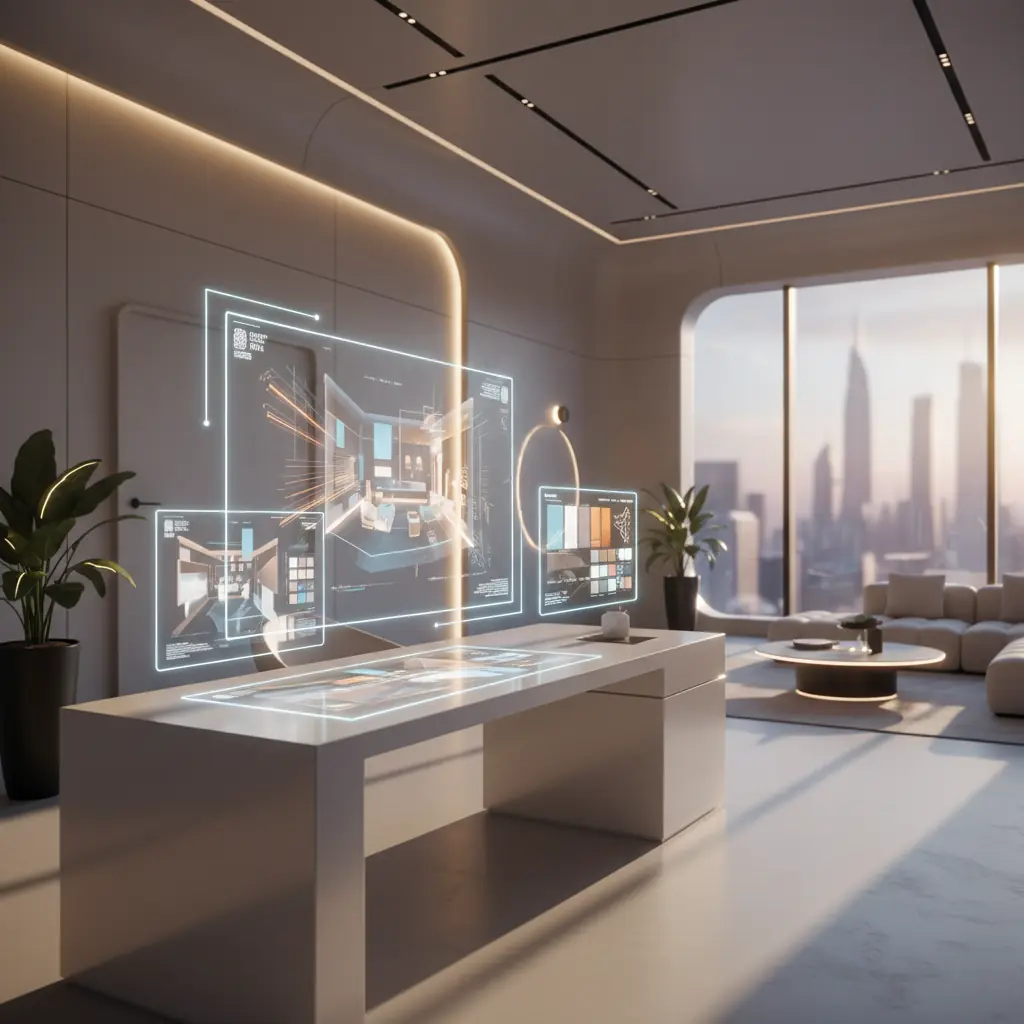
How is AI already transforming professional design workflows?
The landscape of interior design is undergoing a profound transformation, driven by the rapid integration of artificial intelligence. A groundbreaking 2026 survey by the American Society of Interior Designers (ASID) revealed that a staggering 82 percent of professional designers now routinely incorporate AI tools into various parts of their workflow. This figure represents an exponential leap from under 15 percent just two years prior in 2024, demonstrating an adoption curve steeper and more impactful than even the most optimistic predictions.
This swift embrace of AI isn't simply a novelty; it's a testament to the sophistication and tangible results these tools now deliver. The days of struggling with rudimentary AI outputs are largely over. Today's AI-powered design platforms produce concepts realistic and compelling enough to present directly to clients, significantly streamlining the initial creative process.
The fundamental shift isn't about AI replacing human creativity but rather recalibrating where designers invest their most valuable asset: their expertise. Instead of spending laborious hours sketching initial mood boards from scratch or manually compiling endless material palettes, designers can now generate dozens of diverse AI concepts in mere minutes. This revolutionary capability frees them to dedicate their acute design sensibility and honed eye to refining, combining, and adapting the most promising ideas. The creative role has evolved from blank-canvas ideation to a more strategic, curatorial, and refinement-focused approach, enhancing efficiency and expanding creative possibilities. By offloading repetitive and time-consuming tasks, designers report reclaiming up to 70% of their time previously spent on initial concept generation and mood boarding, allowing them to focus on higher-value services and take on more clients.
How does AI democratize interior design for everyone?
Perhaps the most impactful ripple effect of AI in design is the unprecedented democratization of access to professional-quality aesthetics. Historically, engaging an interior designer has been a luxury service, with costs for a single room starting at several thousand dollars, putting it out of reach for the vast majority of homeowners and renters.
AI tools, however, have fundamentally reshaped this barrier. Platforms like Habitas empower anyone with a smartphone to upload a photo of their existing room and, within minutes, witness it transformed into multiple professional-quality styles. This astonishing capability comes at a fraction of the traditional cost, making sophisticated design accessible to a far wider audience. This democratization means homeowners can access sophisticated design ideas for a fraction of the traditional cost, often spending less than $100 for multiple room variations, compared to thousands for a single room design from a human professional.
The impact extends beyond mere affordability; it's about fostering confidence and clarity. Individuals who might never have considered hiring a designer now possess a robust visual vocabulary to articulate their design aspirations. They can walk into a furniture store or browse online knowing precisely the style, color palette, and proportions they are seeking, armed with a clear visual reference. The intimidation barrier that historically prevented many people from engaging with professional design has largely evaporated. To learn more about how this technology works, check out our post on [AI Interior Design: How It Works](/blog/ai-interior-design-how-it-works).
The positive ripple effects resonate throughout the entire home improvement ecosystem. Renovation contractors, for instance, are increasingly reporting that clients arrive with much clearer expectations and more realistic project scopes, backed by tangible AI visualizations. This translates into fewer mid-project changes, reduced miscommunications, more efficient builds, and ultimately, better outcomes and higher satisfaction for everyone involved. For homeowners, this means understanding potential outcomes before committing, significantly de-risking the renovation process.
Will AI replace interior designers, or augment them?
The initial apprehension that AI would entirely supplant human interior designers has, for the most part, not materialized. Instead, what we're witnessing is a profound evolution of the profession. Tasks that once occupied junior designers — generating initial concepts, creating basic mood boards, researching and sourcing furniture options, and even drafting preliminary layouts — are now increasingly handled by AI. This liberation from routine, often repetitive tasks, is not a threat but an opportunity.
It frees experienced designers to concentrate on the aspects they excel at and that AI cannot replicate. These include deeply understanding client lifestyles, preferences, and psychological needs, solving complex spatial and architectural problems, navigating intricate renovation projects, managing budgets and timelines, and curating truly bespoke experiences infused with emotional resonance. The human touch, the empathy, the intuition that transforms a house into a home, remains the exclusive domain of the human designer.
In fact, many top design firms report that integrating AI has not just made their processes more efficient but has actively increased their revenue. Tasks that previously demanded 20 hours of labor-intensive concept development can now be completed in a fraction of that time, perhaps 2-4 hours, with AI generating the visual starting points. This efficiency allows designers to take on a larger volume of projects, offer more competitive pricing for certain services, or dedicate more time to premium, high-touch client relationships. They can now offer clients a rapid iteration process, presenting numerous design directions quickly, allowing for faster decision-making and project progression. Want to see some stunning examples? Visit our [Before & After Room Transformation Guide](/blog/before-after-room-transformation-guide).
What does the end-to-end AI design-to-purchase pipeline look like?
One of the most exciting and transformative developments on the horizon is the emerging end-to-end design-to-purchase pipeline. Envision a future where the journey from inspiration to installation is virtually seamless: you scan your existing room with your phone, receive an array of AI-generated redesign concepts tailored to your space and style, tap on a piece of furniture or decor within the render to instantly view the exact product, its price, availability, and even order it directly – all within a single, unified digital session.
This complete pipeline isn't a distant fantasy; its individual components already exist across various platforms and are rapidly converging. Here’s a breakdown of the key elements:
1. **3D Room Scanning:** The proliferation of LiDAR technology, now standard on recent iPhones and iPads, allows for remarkably accurate 3D scans of interior spaces. These scans capture precise dimensions, spatial relationships, and even existing furniture, providing a rich dataset for AI. 2. **AI Redesign Generation:** Advanced generative AI algorithms leverage this 3D data, combined with user input (style preferences, color palettes, functional needs), to produce hyper-realistic redesign concepts. These designs can instantly apply various aesthetics, from [Art Deco interior design](/blog/art-deco-interior-design) to modern minimalist, complete with new layouts, furniture, and decor. 3. **Product Identification and Matching:** This is a crucial innovation. AI vision systems analyze the generated designs to identify and match furniture, lighting, and decorative items to actual products available for purchase. This can involve linking to exact product SKUs or suggesting very similar alternatives, complete with specifications and pricing. 4. **Integrated E-commerce & Logistics:** The final piece is the ability to add selected items directly to a cart, compare prices from different retailers, and arrange for delivery and even assembly. Some platforms are even exploring partnerships with local contractors for installation of larger items or for managing full-scale renovations.
When this pipeline achieves true seamlessness, the inherent friction between visual inspiration and actionable procurement will drop to nearly zero. This efficiency revolutionizes how people engage with home improvement, making professional-grade design and furnishing decisions faster, simpler, and more accessible than ever before. Properties staged virtually with AI-enhanced designs can sell up to 9% faster and for a higher price point than unstaged homes, according to some real estate analytics, highlighting the immense value of realistic pre-visualization.
How are AR, VR, and Spatial Computing changing design visualization?
Spatial computing, encompassing Augmented Reality (AR) and Virtual Reality (VR), is adding an entirely new dimension to interior design visualization. With the increasing sophistication and mainstream adoption of devices like Apple Vision Pro and Meta Quest, designers and homeowners are moving beyond static images to immersive, interactive experiences.
Imagine standing in your actual living room and, through a headset or even a smartphone screen, seeing an AI-generated redesign overlaid onto your existing space in real-time. The new furniture is scaled to real-world proportions, the walls are painted with the chosen color, and light realistically interacts with the virtual elements. You can "walk through" your proposed Japandi redesign, observe how light falls through your actual windows onto the virtual elements, and even interact with virtual objects. This level of immersion provides an unparalleled sense of presence and allows for a far more intuitive understanding of how a design will feel in reality. This technology significantly reduces the risk of making costly mistakes, as you can virtually "try before you buy" on a grand scale. For example, you could virtually try out various [color schemes for living rooms](/blog/color-schemes-for-living-rooms) directly in your space.
While this technology is still in its nascent stages for mass consumer adoption — headset costs remain relatively high, and the experience requires a degree of technical comfort — the trajectory is unmistakably clear. Within three to four years, visualizing a complex redesign in augmented reality will likely become as natural and commonplace as viewing it in a high-quality static photo is today. This will transform client presentations, allow homeowners to make more confident decisions, and provide designers with an incredibly powerful tool for spatial problem-solving. It’s a leap from simply seeing a design to truly _experiencing_ it.
Key Predictions for AI in Design: 2027 to 2030
The pace of innovation in AI shows no signs of slowing, promising an even more integrated and sophisticated future for interior design. Here are some key predictions for the next few years:
- **Late 2027:** AI-generated room designs will become virtually indistinguishable from professional photography. The fidelity will reach a point where discerning between a rendered image and a carefully staged real-world photo will be exceedingly difficult, further enhancing client presentations and marketing materials. Check out how realistic they can be now in our post on [Are AI-Generated Room Designs Realistic?](/blog/ai-generated-room-designs-realistic). - **Early 2028:** Product matching accuracy – the ability of AI to identify and link to exact or near-exact purchasable items within generated designs – will achieve 90 percent reliability. This significant improvement will solidify the end-to-end design-to-purchase pipeline, making it a dependable resource for both designers and consumers. - **Mid-2028:** Automated cost estimation for renovations, leveraging AI's ability to analyze materials, labor, and regional pricing data, will become accurate enough for preliminary budgeting. This will provide homeowners with realistic financial expectations much earlier in the planning process, reducing sticker shock and improving project forecasting. - **Late 2028:** AI will begin to play a significant role in **sustainable design**. By analyzing material properties, lifecycle assessments, and local availability, AI tools will recommend the most eco-friendly and energy-efficient options, aiding designers in creating truly sustainable spaces. AI's ability to optimize material selection and spatial planning could lead to a 10-20% reduction in material waste in large-scale renovation projects by 2030. - **2029:** Expect to see the rise of **hyper-personalized design**, where AI not only generates designs based on stated preferences but also learns from user interactions, past purchases, and even biometric data (with consent) to create spaces that anticipate and respond to individual needs and moods. This could involve dynamically adjusting lighting, temperature, or even scent profiles. - **By 2030:** We anticipate the advent of fully integrated renovation platforms. Imagine scanning a room, choosing a design direction (perhaps from [the best interior design styles of 2026](/blog/best-interior-design-styles-2026)), receiving accurate pricing for the entire project, hiring vetted local contractors, and tracking the project's progress – all through one intuitive interface. Designers will increasingly evolve into "design strategists," focusing on the deeply human elements that AI cannot replicate: understanding how a family truly lives, anticipating needs five or ten years into the future, fostering emotional connections with spaces, and navigating the complexities of human-centric project management.
The future of interior design is not about AI versus designers; it's about AI amplifying what good design can be, making it more accessible, efficient, and deeply personalized than ever before. It's about empowering creativity and enhancing human connection within our built environments.
Frequently Asked Questions
### Is AI going to replace interior designers?
No, AI is not expected to replace interior designers. Instead, it is augmenting their capabilities and transforming the profession. AI tools handle repetitive, time-consuming tasks like initial concept generation, mood boarding, and furniture sourcing. This frees human designers to focus on higher-value activities that require uniquely human skills: understanding client psychology, solving complex spatial problems, managing intricate projects, and curating emotionally resonant spaces. The profession is evolving, with designers becoming more strategic and client-focused.
### How much does AI interior design cost compared to traditional design services?
AI interior design tools offer a significantly more affordable alternative to traditional design services. While hiring a professional interior designer can cost thousands of dollars for a single room, AI platforms like Habitas typically charge a small fraction of that, often less than $100 for multiple design variations. This cost efficiency democratizes access to professional-quality design ideas for a much wider audience, including homeowners and renters on a budget.
### What are the benefits of using AI for home design?
The benefits of using AI for home design are numerous. It democratizes access to professional-quality visualizations, making sophisticated design affordable for everyone. AI dramatically speeds up the design process, generating multiple concepts in minutes compared to weeks for traditional methods. It helps homeowners visualize changes with confidence, reducing costly mistakes and miscommunications during renovations. For professionals, AI enhances efficiency, allowing them to take on more clients and focus on the creative, human-centric aspects of their work.
### How accurate are AI-generated room designs?
Modern AI-generated room designs are remarkably accurate and hyper-realistic. With advancements in generative AI and 3D rendering, the outputs can be virtually indistinguishable from professional photography by late 2027. They accurately apply chosen styles, integrate furniture to scale, and even simulate lighting conditions realistically within your actual room photo. This high level of fidelity allows users to truly visualize how a space will look and feel before making any commitments.
### Can AI help me choose furniture and decor?
Absolutely. AI tools are becoming increasingly sophisticated at helping users choose furniture and decor. Beyond just generating design concepts, the emerging end-to-end AI pipeline will allow you to tap on specific items within an AI-generated render to see the exact product, its price, and availability. AI can also learn your style preferences to recommend suitable pieces, helping you curate your space with unprecedented ease and confidence. This significantly streamlines the process from inspiration to purchase.