Telas Inteligentes con Respuesta Solar vs. Cortinas Térmicas Tradicionales: ¿Cuál Gana en 2026?
Una inmersión profunda en el futuro de los tratamientos de ventanas. Descubre si los textiles inteligentes con respuesta solar o las cortinas térmicas clásicas ofrecen la mejor eficiencia energética y retorno de inversión para tu hogar.
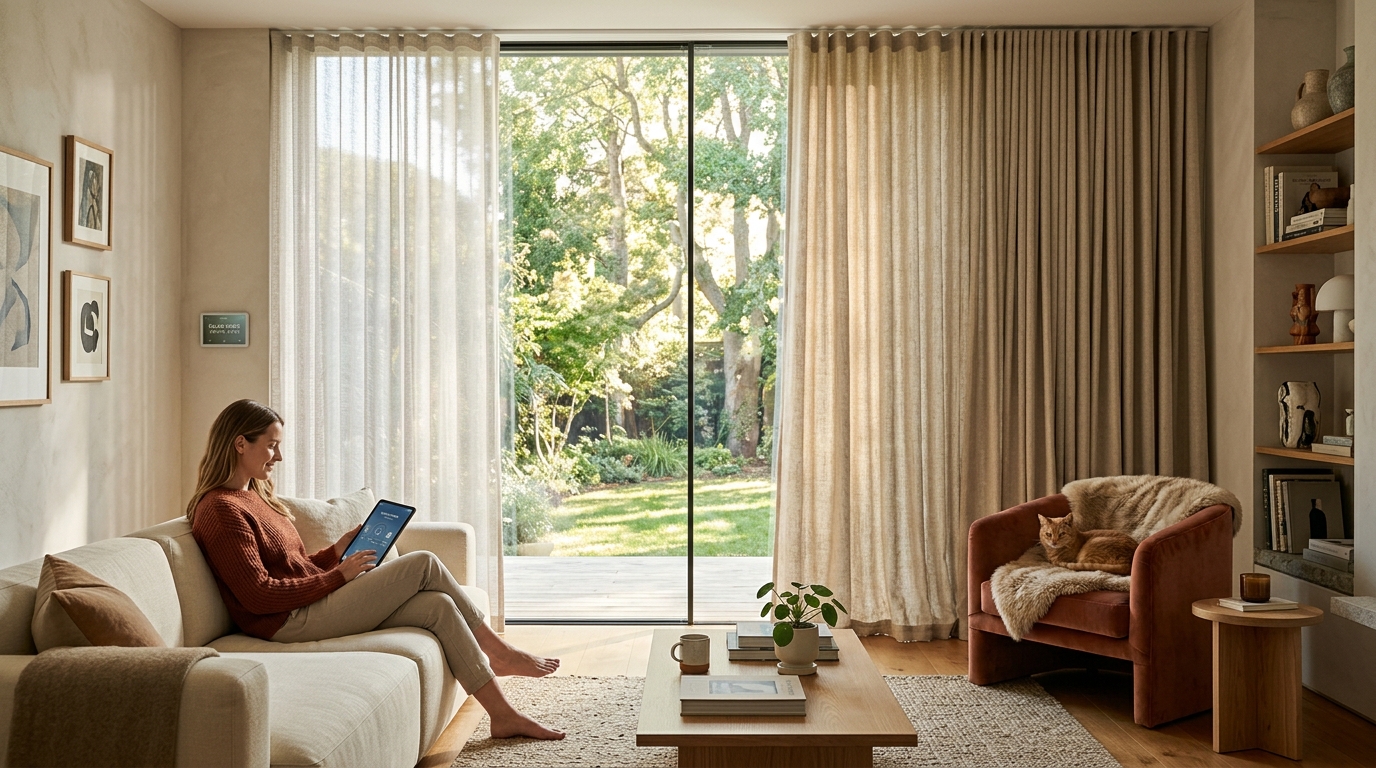
La Evolución de la Ventana en el Hogar Inteligente de 2026
Hace una década, los tratamientos de ventanas "inteligentes" significaban poco más que barras motorizadas controladas por una aplicación de smartphone. Hoy, la definición se ha expandido para incluir materiales que son fundamentalmente reactivos a nivel molecular. La ventana moderna es parte de un ecosistema holístico que incluye [iluminación biométrica impulsada por IA para el bienestar mental](/blog/ai-driven-biometric-lighting-for-mental-wellness) y sistemas de climatización que respiran en sincronía con los ocupantes.
Las telas con respuesta solar son la última iteración de esta evolución. Estos materiales no solo bloquean la luz; la procesan. Para 2026, se proyecta que el mercado de estos textiles alcance un estimado de $11.4 mil millones a nivel mundial, impulsado por una creciente clase media que busca formas pasivas de reducir la huella de carbono. Por otro lado, las cortinas térmicas tradicionales también han visto mejoras, utilizando nuevas mezclas sintéticas recicladas y tecnologías avanzadas de atrapamiento de "aire muerto" que las hacen más efectivas que nunca.
¿Qué Son las Telas Inteligentes con Respuesta Solar?
Para entender por qué las telas con respuesta solar son revolucionarias, debemos observar su composición. A diferencia de las telas estándar, estos textiles están incrustados con materiales cromogénicos, específicamente compuestos termocrómicos y fotocrómicos. Estas moléculas cambian su estado físico en respuesta al calor o la intensidad de la luz.
Cuando el sol incide sobre una tela inteligente en 2026, el material puede oscurecerse automáticamente para reducir el resplandor o cambiar su orientación para reflejar la radiación infrarroja hacia el exterior. Algunas versiones de alta gama utilizan capas de cristal líquido que pueden cambiar de transparente a opaco en milisegundos. Estos sistemas a menudo están conectados a la IA central del hogar, permitiendo que los tratamientos de ventanas se comuniquen con el termostato para prevenir la ganancia de calor por "efecto invernadero" antes de que ocurra.
Cortinas Térmicas Tradicionales: Por Qué Siguen Siendo Importantes en 2026
Aunque carecen de la "inteligencia" de sus contrapartes inteligentes, las cortinas térmicas tradicionales están lejos de ser obsoletas. La versión 2026 de una cortina térmica es a menudo una obra maestra de ingeniería de triple capa. La capa que mira hacia la habitación es típicamente una tela decorativa —quizás utilizando [textiles de punto 3D frente a la tapicería tradicional](/blog/3d-knit-textiles-vs-traditional-upholstery) para una textura adicional—, mientras que la capa intermedia es una espuma o vellón de alta densidad, y la capa exterior es una película reflectante de barrera de vapor.
La principal ventaja de las cortinas térmicas sigue siendo su valor R (resistencia al flujo de calor). Debido a que suelen ser más pesadas y crean un sellado más hermético contra el marco de la ventana que muchas telas inteligentes delgadas, son excepcionalmente buenas para prevenir la pérdida de calor durante los meses de invierno cuando las telas inteligentes no tienen nada a qué "responder". Para muchos, la comodidad táctil de una pesada cortina de terciopelo o mezcla de lana proporciona una calidez psicológica que una película de alta tecnología simplemente no puede replicar.
Eficiencia Energética: Los Números Concretos
Al elegir entre estos dos, la decisión a menudo se reduce a los datos. Según auditorías energéticas recientes de 2026, las diferencias de rendimiento son marcadas dependiendo de la zona climática.
* **Reducción de la carga de enfriamiento:** Las telas con respuesta solar pueden reducir los requisitos de enfriamiento de una habitación hasta en un 42% en ambientes de alta radiación UV (como el Cinturón del Sol o el sur de Europa) al reflejar el 90% de la radiación solar antes de que ingrese a través del vidrio. * **Retención de calor:** Las cortinas térmicas tradicionales superan a las telas inteligentes en retención de calor, siendo capaces de reducir la pérdida de calor a través de las ventanas en un 25% a 30% durante las noches de invierno, cuando las telas inteligentes no tienen nada a qué "responder". * **Eficiencia de costos:** Un sistema de cortinas térmicas estándar de alta calidad para una casa de 3 dormitorios promedia alrededor de $1,200–$1,800. Un sistema de respuesta solar totalmente integrado se sitúa actualmente entre $4,500 y $7,000, incluyendo los sensores de IA y la integración de energía necesarios.
Aunque el costo inicial de las telas inteligentes es significativamente mayor, el retorno de inversión a largo plazo se encuentra en la reducción automatizada del uso de energía en horas pico, que muchos proveedores de servicios públicos ahora recompensan con tarifas más bajas de "red inteligente".
Cómo la Integración de IA Cambia la Experiencia de Usuario
El verdadero ganador en el hogar de 2026 no es solo la tela; es el software que la respalda. Los propietarios modernos utilizan cada vez más [aplicaciones de diseño de interiores con IA comparadas en 2026](/blog/ai-interior-design-apps-compared-2026) para simular cómo reaccionarán los diferentes materiales a sus coordenadas geográficas específicas.
Habitas, por ejemplo, permite a los usuarios cargar una foto de su espacio y simular cómo las telas con respuesta solar cambiarán de color y opacidad a lo largo de un ciclo de 24 horas. Esto elimina las conjeturas de la compra. En lugar de preguntarse si una tela será demasiado oscura a las 4:00 p.m., la IA muestra exactamente cómo se filtrará la luz. Este nivel de integración asegura que el aspecto "inteligente" de la tela no sea un truco, sino una solución de control climático personalizada.
¿Pueden las Telas Inteligentes Igualar la Estética de las Cortinas Tradicionales?
Una de las quejas históricas contra los tratamientos de ventanas inteligentes era que parecían persianas de oficina o equipo de laboratorio. Eso cambió en 2025 con el auge de la estética "tecno-orgánica". Ahora vemos telas inteligentes que imitan la caída del lino y el brillo de la seda, mientras ocultan hilos conductores dentro del tejido.
Sin embargo, las cortinas térmicas tradicionales aún ostentan la corona en cuanto a lujo y "hygge". Hay una profundidad de color y una suavidad de pliegue en un pesado cortinaje térmico que la tecnología actual de telas inteligentes lucha por lograr. Si estás diseñando una biblioteca acogedora o un comedor formal, el peso visual de una cortina tradicional es a menudo la elección de diseño superior. Los diseñadores suelen comparar estos resultados en una galería [antes y después del diseño de interiores con IA](/blog/ai-interior-design-before-and-after) para ver qué ambiente se ajusta mejor a las necesidades emocionales del cliente.
Durabilidad y Mantenimiento: Una Proyección a 10 Años
Al invertir en materiales para el hogar, la longevidad es clave. Las cortinas térmicas tradicionales son relativamente fáciles de mantener: la mayoría se pueden limpiar en seco o aspirar. Su vida útil es generalmente de 10 a 15 años, aunque el revestimiento térmico puede eventualmente agrietarse si se expone a rayos UV extremos durante largos períodos.
Las telas inteligentes con respuesta solar son más complejas. Debido a que contienen compuestos activos o componentes electrónicos integrados, son más sensibles a los productos químicos de limpieza agresivos. La mayoría de los textiles inteligentes de 2026 están clasificados para aproximadamente 50,000 "cambios" (cambiando de claro a oscuro), lo que generalmente equivale a una vida útil de 8 a 12 años. Si un sensor falla o el puente de IA se vuelve obsoleto, la tela "inteligente" esencialmente se convierte en una cortina estándar, un factor de riesgo que muchos propietarios con presupuesto limitado deben considerar.
¿Qué Tratamiento es Mejor para Tu Salud?
La salud y el bienestar se han vuelto centrales en el diseño de interiores. Las telas con respuesta solar son las claras ganadoras para la regulación del ritmo circadiano. Al ajustar automáticamente los niveles de luz a lo largo del día, ayudan a mantener el ciclo natural de sueño-vigilia del cuerpo, previniendo el bajón de energía de media tarde causado por habitaciones excesivamente brillantes u oscuras.
Las cortinas térmicas, sin embargo, son superiores para la salud acústica. Su densidad las convierte en increíbles absorbedores de sonido. Para hogares en centros urbanos con alto ruido callejero, una cortina térmica pesada puede reducir los niveles de ruido percibidos hasta en 10 decibeles. En 2026, donde el "lujo silencioso" es una tendencia importante, el silencio proporcionado por una cortina térmica es un lujo en sí mismo.
Sostenibilidad: La Comparación de la Huella de Carbono
La sostenibilidad en 2026 se mide tanto por el "carbono incorporado" (la energía utilizada para fabricar el producto) como por el "carbono operativo" (la energía que el producto ahorra).
Las cortinas térmicas tradicionales a menudo ganan en carbono incorporado, especialmente cuando están hechas de lana reciclada o plásticos oceánicos. Sin embargo, las telas con respuesta solar ganan en carbono operativo. Al reducir significativamente la necesidad de aire acondicionado —que sigue siendo uno de los mayores contribuyentes a las emisiones de carbono residenciales—, las telas inteligentes a menudo "pagan" su deuda de carbono dentro de los 3 años posteriores a la instalación.
En Habitas, enfatizamos que el producto más sostenible es aquel que no tienes que reemplazar. Por eso recomendamos versiones duraderas y de alta calidad de ambas tecnologías, en lugar de alternativas baratas y desechables que terminan en los vertederos en dos temporadas.
Complejidad de la Instalación y Potencial DIY
Si eres un entusiasta del DIY, las cortinas térmicas tradicionales son la opción obvia. Requieren una barra estándar y medidas básicas. Las telas con respuesta solar, sin embargo, a menudo requieren cableado de "bajo voltaje" o sofisticados sistemas de recarga de baterías integrados en la cenefa.
Muchas telas inteligentes de 2026 también requieren una calibración profesional para sincronizarse con la IA del hogar. Esto puede agregar un 15% a 20% adicional al costo total de instalación. Para aquellos que desean una solución de "configurar y olvidar" sin que un técnico visite su hogar, las cortinas térmicas siguen siendo el camino de menor resistencia.
El Veredicto: ¿Cuál Gana en 2026?
El ganador depende enteramente de tu prioridad:
* **Elige Telas Inteligentes con Respuesta Solar si:** Vives en un clima de altas temperaturas, priorizas la tecnología de vanguardia, deseas un hogar inteligente totalmente automatizado y tienes un presupuesto inicial mayor para ahorros de energía a largo plazo. * **Elige Cortinas Térmicas Tradicionales si:** Vives en un clima frío, valoras la privacidad acústica y la estética "acogedora", tienes un presupuesto limitado o prefieres una decoración de bajo mantenimiento y duradera.
En muchos diseños de alta gama de 2026, en realidad estamos viendo un **enfoque híbrido**: una cortina de velo con respuesta solar para la gestión de la luz diurna, combinada con un pesado cortinaje térmico para el aislamiento nocturno y el estilo.
La Gente También Pregunta
### 1. ¿Son seguras las telas inteligentes para hogares con mascotas y niños? Sí. Para 2026, la mayoría de las telas con respuesta solar están diseñadas sin cables, eliminando un importante riesgo de seguridad. Los componentes de bajo voltaje suelen estar encapsulados en carcasas ignífugas, haciéndolos tan seguros como cualquier otro dispositivo electrónico doméstico.
### 2. ¿Puedo lavar las cortinas con respuesta solar en una lavadora? Generalmente, no. La mayoría de los textiles inteligentes requieren limpieza en seco especializada o limpieza "ultrasónica" para evitar dañar las moléculas reactivas o los sensores incrustados. Siempre verifica las pautas del fabricante de 2026.
### 3. ¿Funcionan las telas inteligentes en días nublados? Sí. Los materiales fotocrómicos responden a los niveles de UV, que aún penetran la capa de nubes. Además, la mayoría de los sistemas integrados con IA utilizan datos meteorológicos locales para ajustar el estado de la tela incluso cuando la luz solar directa no incide sobre la ventana.
### 4. ¿Cuánto dinero puedo realmente ahorrar en mi factura de energía? En promedio, un hogar que utiliza telas inteligentes en un clima templado puede ahorrar entre $300 y $600 anualmente en costos de enfriamiento. Las cortinas térmicas tradicionales pueden ahorrar entre $150 y $400 en costos de calefacción en regiones más frías.
### 5. ¿Las telas inteligentes quedarán obsoletas cuando la tecnología se actualice? La mayoría de las telas inteligentes de 2026 están diseñadas con controladores "modulares". Si bien la tela en sí sigue siendo funcional durante una década, el puente de IA o el sensor generalmente se pueden reemplazar o actualizar mediante software, de manera similar a un televisor inteligente o un termostato.
### 6. ¿Estas telas ayudan a prevenir la decoloración de los muebles? Las telas con respuesta solar son excepcionales para prevenir el daño UV. Pueden bloquear hasta el 99% de los dañinos rayos UV, extendiendo significativamente la vida útil de tus pisos, obras de arte y muebles en comparación con las cortinas estándar.