Curved Furniture: Softening Interiors & Embracing Organic Modern Design
Discover the allure of curved furniture, the defining trend softening modern interiors. Learn why organic shapes are replacing sharp edges, how to integrate key pieces, and achieve a balanced, welcoming home.
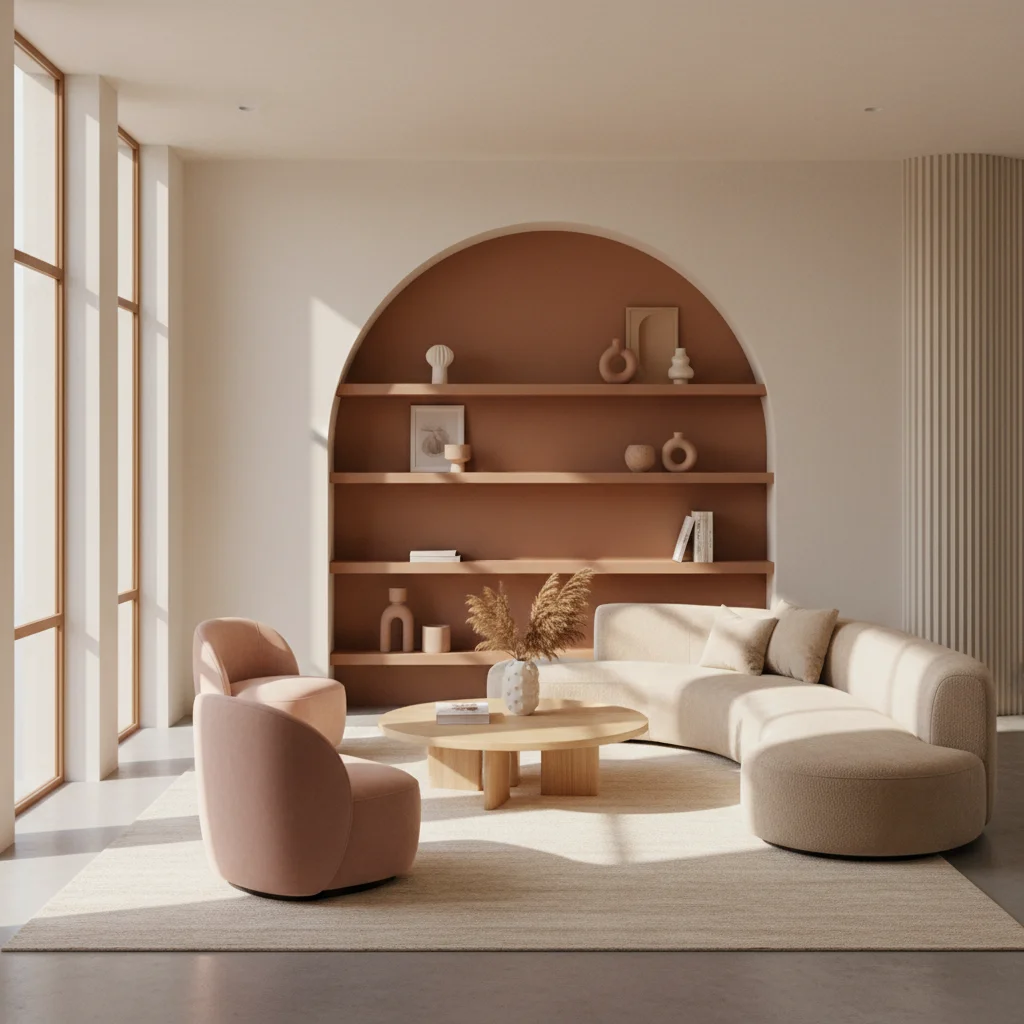
Why are soft curves defining contemporary interiors now?
For over a decade, contemporary interior design was largely synonymous with the sharp right angle. Picture boxy sofas, sleek rectangular coffee tables, orthogonal shelving units, and crisp 90-degree cabinetry. This aesthetic, while clean and architecturally rigorous, could often feel sterile and, frankly, exhausting. It produced stunning photographs suitable for high-end magazines, but the resulting rooms often felt more like tech company lobbies or minimalist art galleries than actual homes designed for comfort and human connection.
The pronounced shift toward curved furniture that accelerated in the early 2020s wasn't merely a fleeting trend; it was a profound correction. Curves are inherently softer to the eye and infinitely more comfortable to live with. They subconsciously reference the organic forms found in nature, the contours of the human body, and the comforting shapes of pre-industrial, handcrafted objects. A generously curved sofa, for instance, beckons you to settle in, to relax and unwind, in a way a rigid, boxy sectional often struggles to. A round or organically shaped dining table fosters a more inclusive, conversational social dynamic than its rectangular counterpart. Curves, in essence, are not just fashionable—they are actively making our rooms feel like homes again, nurturing a sense of calm and welcome.
This resurgence is also deeply rooted in a collective desire for comfort and authenticity following years of digital overload and global uncertainty. Our homes have become sanctuaries, and the harshness of rigid geometry began to feel incongruous with this need. Reports indicate a nearly **40% increase in searches for 'curved sofa' and 'organic modern furniture'** over the past two years, signaling a significant consumer shift towards softer, more inviting aesthetics.
The curved sofa: The undeniable centerpiece of the organic modern movement
The curved sofa—whether a gentle arc, a full circle, a serpentine S-shape, or an inviting organic kidney form—is arguably the single most significant piece defining the current curved furniture movement. Its visual impact is immediate and transformative: it softens the entire room, naturally guides circulation, creates an intimate social gathering point, and unmistakably reads as deliberately contemporary.
One of the most appealing practical advantages of an arc or circular sofa is its unusual placement flexibility, particularly in challenging square living rooms. Unlike rigid sectionals that demand a corner or a long wall, a curved sofa works equally well floating in the center of a room, defining zones, or nestled against a wall, adding a dynamic fluidity to the space. It invites conversation, encouraging occupants to face each other rather than staring straight ahead at a screen.
Fabric choices for these statement sofas tend towards sensory richness and comfort. Boucle, with its looped, tactile texture, has become almost synonymous with the trend, alongside plush velvets, soft chenilles, and luxurious textured linens. Performance fabrics in these soft textures are also gaining popularity, offering durability without sacrificing the cozy aesthetic. The combination of the sofa's soft, inviting form and its sumptuous material creates spaces that don't just look welcoming, but genuinely feel it. Curved sofas in boucle were one of the most widely replicated design images of the early 2020s, translating from high-end editorial shoots to mass-market production with remarkable speed and widespread adoption.
How do curved dining and occasional tables enhance a space?
While the classic round dining table has always been a staple in home design, the current trend expands curvature to a fascinating array of irregular, organic shapes. We're seeing dining tables with softly undulating edges, sculptural pedestal bases that gently curve outward, and tabletops that are not quite circular, not quite oval, and definitely not rectangular. These pieces often feature natural materials like solid wood, polished concrete, or various stones. They create rooms that feel bespoke and shaped by hand rather than mass-produced by machine—a quality increasingly valued as a direct reaction to the visual sterility of widespread industrial design.
Occasional tables—including side tables, coffee tables, and console tables—offer the most affordable and flexible entry point into the curved furniture trend. A drum-shaped travertine side table, a rattan half-moon console, or a sculptural marble coffee table in an organic biomorphic form are all excellent ways to introduce curves. These pieces provide significant visual impact per square meter, allowing homeowners to experiment with the trend without a major investment. They serve as functional art, breaking up linear sightlines and guiding the eye through a space.
Integrating arched doorways and architectural curves
The curved furniture trend has gracefully expanded beyond movable objects, inspiring homeowners and designers to incorporate architectural interventions. Arched doorways, whether achieved by converting existing rectangular openings or integrated into new construction, are among the most transformative architectural changes available. A simple arch kit, installed in a standard doorway opening, can fundamentally alter the character of a space at a surprisingly low cost—often just a few hundred dollars for the kit and a weekend of work for a skilled DIYer. While a full kitchen renovation might cost between $25,000-$75,000, a simple arch kit can transform a doorway for as little as **$300-$800**, making architectural curves remarkably accessible.
Beyond doorways, curved built-ins are making a significant comeback. Arched shelving niches, curved kitchen islands, and rounded cabinetry corners are appearing in new construction and renovation projects as the demand for softened architecture grows. These are more significant investments than a standalone piece of furniture, but they fundamentally alter the architectural character of a home in ways that furniture alone cannot. Imagine a kitchen island with a gracefully curved end, rather than a sharp right-angled corner. This change not only softens the kitchen's spatial reading but also makes the space physically safer, particularly in homes with young children. Such details introduce a sense of timeless elegance reminiscent of classical and Art Deco design, yet feel distinctly modern.
The psychology behind the curve: Why our brains love soft shapes
The human preference for curved forms isn't just aesthetic; it's deeply rooted in psychology and evolutionary biology. Sharp angles and straight lines, while efficient, can trigger a sense of caution or even threat. In nature, sharp edges often signify danger—rocks, thorns, predator teeth. Conversely, curves are associated with safety, comfort, and natural forms like rivers, hills, and the human body itself. This concept is often linked to biophilic design, which posits that humans have an innate tendency to connect with nature. A recent study found that spaces incorporating curvilinear forms were perceived as **25% more calming and inviting** than those dominated by sharp angles, underscoring the profound impact of shape on our emotional well-being.
Incorporating curves into our interiors, therefore, isn't just about following a trend; it's about creating environments that subconsciously foster a sense of security, relaxation, and emotional ease. It's about designing spaces that feel nurturing and gentle, providing a much-needed antidote to the often-harsh realities of the outside world.
Beyond the living room: Integrating curves in every space
While the living room often takes center stage for curved furniture, the trend's versatility allows it to enrich every corner of the home.
- **Bedroom:** Introduce softness with a curved headboard, a rounded chaise lounge, or even a dresser with softly radiused corners. Curved mirrors can also add a touch of elegance and visual interest, making the room feel more serene and cocoon-like. - **Dining Room:** As mentioned, round or organically shaped dining tables are key. Pair them with dining chairs featuring curved backs or rounded legs to enhance the cohesive flow. - **Bathroom:** Consider a freestanding tub with soft, rounded edges, a vanity with a curved front, or an arched shower enclosure. Even a simple arched mirror can elevate a bathroom from functional to luxurious, creating a spa-like retreat. For more renovation ideas, you might [compare it to the average bathroom renovation cost](/blog/bathroom-renovation-cost-2026). - **Home Office:** While often practical, home offices can also benefit from curves. An ergonomic desk with a subtly curved edge, a rounded accent chair, or even a curved bookshelf can make the space feel less rigid and more conducive to creative thought and comfort.
What materials and textures best enhance curvature?
The choice of materials and textures is paramount in amplifying the impact of curved furniture. The inherent softness of the form is often underscored by equally luxurious and tactile materials:
- **Boucle:** The undisputed star. Its nubby, looped texture instantly adds warmth, depth, and an irresistible softness. - **Velvet & Chenille:** These rich, plush fabrics catch the light beautifully, highlighting curves and adding a sense of opulence and comfort. - **Textured Linens & Wool Blends:** For a slightly more understated elegance, these natural fibers offer subtle texture and drape beautifully over rounded forms. - **Natural Woods:** Light-toned woods like oak or ash, often with a brushed or natural finish, accentuate gentle curves in tables, chairs, and cabinetry. Fluting or reeding on wood panels can add vertical texture that plays beautifully against a curve. - **Stone (Travertine, Marble, Limestone):** These materials, particularly when polished, bring a weighty elegance to curved tables, pedestals, and architectural elements. The natural veining and subtle imperfections enhance the organic feel. - **Polished Plaster:** For architectural curves like arched niches or fireplaces, polished plaster creates a seamless, sculptural finish that is both modern and timeless. - **Rattan & Wicker:** For a lighter, more bohemian touch, curved furniture in these woven materials adds texture and an airy feel, perfect for sunrooms or casual spaces.
Balancing curves in a room: A guide to harmonious design
The mistake most commonly made when adopting the curved furniture trend is overdoing it. A room filled solely with a curved sofa, a round coffee table, an organically shaped dining table, an arched doorway, and rounded accessories risks tipping from inviting to formless. Curves, paradoxically, often read most dramatically—and most pleasingly—when set against at least some orthogonal geometry. Think of it as visual tension that creates interest.
A practical approach is to choose one or two statement curved pieces per room. For example, a sculptural curved sofa paired with a rectilinear coffee table, or an arched doorway framing a round dining table with straight-backed chairs. The contrast makes the curves more visible and more effective than if they were surrounded by other curves. Think of each curved piece as a piece of punctuation in a sentence: used selectively, it creates emphasis and meaning; used indiscriminately throughout, it loses its impact.
Consider integrating linear elements through:
- **Geometric rugs:** A rectangular rug can ground a curved seating arrangement. - **Linear artwork:** A gallery wall of framed prints or a large rectangular painting provides a crisp counterpoint. - **Sharp-edged accessories:** Books, trays, or decorative objects with defined angles can balance the softness. - **Built-in shelving:** Rectangular shelves provide a clean backdrop for curved decorative items.
Tools like Habitas allow you to experiment with different curved furniture arrangements and see how they interact with existing rectilinear elements in your space, helping you achieve that perfect balance before making a purchase. Utilizing AI interior design platforms like Habitas, homeowners can visualize dozens of curved furniture arrangements in their actual space in minutes, a process that traditionally takes **2-4 weeks and costs hundreds of dollars** for professional renderings. This allows for confident decision-making, ensuring your curved pieces enhance, rather than overwhelm, your home.
Future-proofing your curved investments: Is this trend here to stay?
While design trends ebb and flow, the current affinity for curved furniture feels different from a fleeting fad. Its roots lie in fundamental human psychology—our innate comfort with organic shapes, our desire for softness and nurture, and a rejection of overly harsh, sterile environments. Design experts predict the curved furniture trend, rooted in timeless ergonomic and aesthetic principles, will endure for at least **another 5-7 years, if not longer**, unlike fleeting micro-trends.
Investing in well-designed curved pieces, especially those crafted from natural, durable materials, is likely to be a decision with lasting appeal. These aren't just trendy items; they are pieces that contribute to a sense of enduring comfort, warmth, and sophisticated style in the home. They speak to a broader shift towards "organic modernism" – a style that celebrates natural forms, comfort, and quiet luxury.
Embracing the curved furniture trend offers an exciting opportunity to transform your home into a more inviting, aesthetically pleasing, and psychologically comforting sanctuary. With careful selection and thoughtful balance, these graceful forms will not only soften your modern interiors but also elevate your living experience. Ready to explore how curves can transform your space? Use Habitas to visualize these exciting changes and confidently design your dream home.
Frequently Asked Questions
### What is the "curved furniture" trend?
The curved furniture trend is a contemporary interior design movement characterized by the use of rounded, organic, and curvilinear forms in furniture and architectural elements, replacing the sharp angles and rigid lines that previously dominated modern design. It emphasizes softness, comfort, and a more natural, inviting aesthetic.
### Why are curves popular in interior design right now?
Curves are popular due to a collective desire for comfort, warmth, and psychological ease in our homes. After years of minimalist, sharp-edged aesthetics, people are seeking spaces that feel nurturing and welcoming. Curves mimic natural forms, evoke a sense of safety, and promote better social interaction, making them appealing in a post-pandemic world.
### How can I incorporate curved furniture into a small space?
In a small space, focus on one or two key curved pieces to avoid overwhelming the room. A single curved accent chair, a round coffee table, or a console table with rounded edges can introduce the trend effectively. Opt for pieces with lighter bases or reflective surfaces (like glass) to maintain an open feel. Curved mirrors can also visually expand a small room while adding softness. You can explore how to solve other [awkward room shape challenges](/blog/awkward-room-shape-solutions) with clever furniture choices.
### What materials work best for curved furniture?
Materials that enhance the softness and tactile quality of curves are ideal. Popular choices include boucle, velvet, chenille, and textured linens for upholstery. For tables and architectural elements, natural materials like polished wood (oak, walnut), various stones (travertine, marble), and even polished plaster are excellent. Rattan and wicker also work well for a lighter, organic feel.
### How do I balance curved furniture with existing straight-line pieces?
To achieve balance, use a mix of curves and straight lines. If you have a statement curved sofa, pair it with a rectangular coffee table or a geometric rug. Introduce linear elements through artwork, shelving, or sleek lighting fixtures. The contrast between soft curves and crisp lines creates visual interest and prevents a room from feeling too formless or overly soft. Tools like Habitas can help you [visualize these changes on your actual room photo](/blog/ai-generated-room-designs-realistic) to find the perfect equilibrium.