How to Design an AI-Optimized Multisensory Sleep Sanctuary
Discover the future of bedroom design with our comprehensive guide on creating an AI-powered, multisensory sleep sanctuary for optimal recovery and wellness.
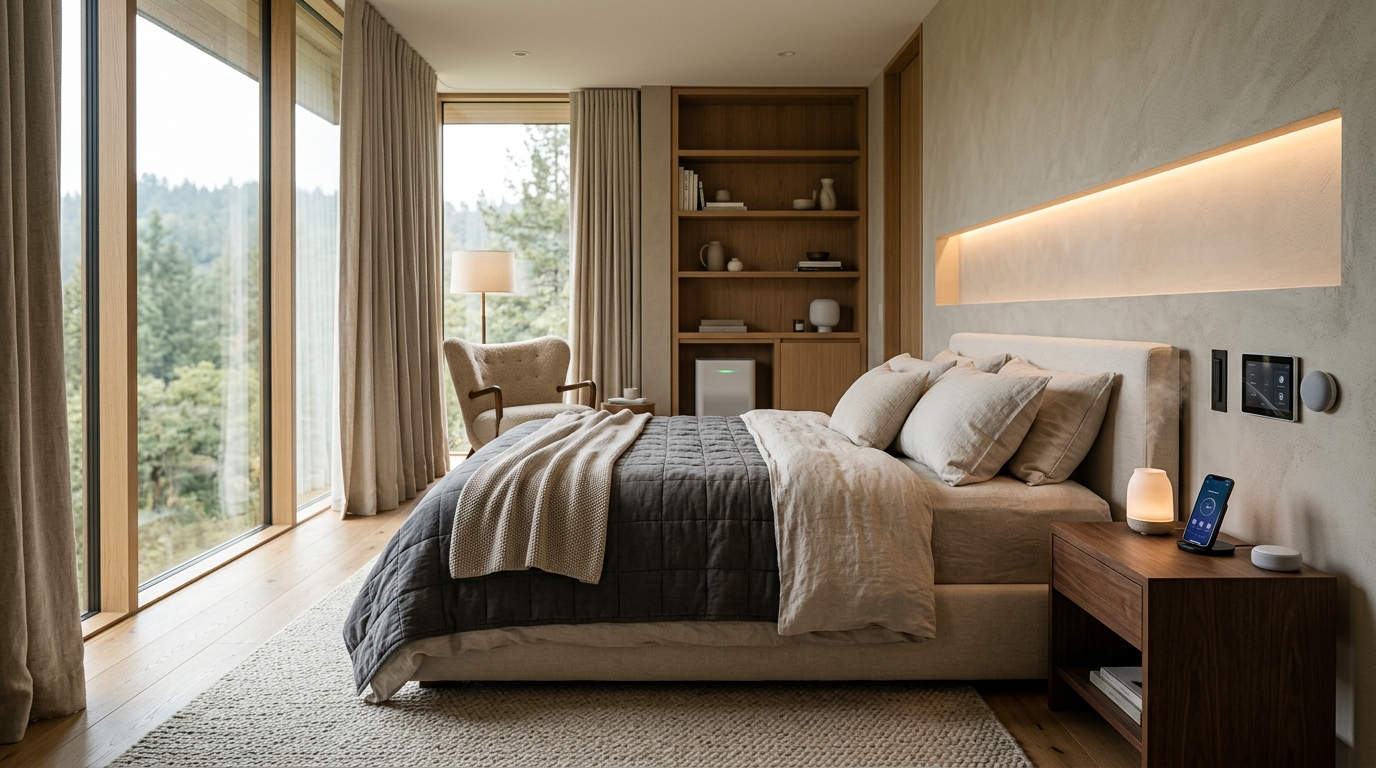
What is an AI-Optimized Multisensory Sleep Sanctuary?
An AI-optimized sleep sanctuary is a bedroom designed using algorithmic insights to control environmental variables like light, sound, temperature, and air quality. Unlike traditional interior design, which focuses primarily on aesthetics, this approach prioritizes "biophilic synchronization."
In 2026, we use AI to analyze your personal biometric data (from your wearable or smart mattress) and adjust the room's environment in real-time. This means your bedroom actually "learns" your sleep cycles. If your core body temperature rises, the room cools. If your REM cycle is interrupted by street noise, the acoustic system generates counter-frequencies. This is a living, breathing ecosystem designed with a singular goal: the perfect night’s sleep.
Step 1: Mapping the Foundation with AI Space Planning
Before you choose a single paint color or fabric swatch, you must address the layout. The flow of air and the placement of the bed in relation to windows and doors (often referred to as the "command position" in Neuro-architecture) are critical.
Using an [ai-furniture-arrangement-tool](/blog/ai-furniture-arrangement-tool), you can upload a scan of your room to determine the mathematically optimal position for your bed. This avoids "dead zones" where air stagnates and ensures that morning light hits your face at the precise angle required to trigger cortisol release at your desired wake-up time.
At Habitas, we recommend using these AI tools to simulate how different furniture heights and placements affect the room’s "acoustic bounce." A bed placed too close to a reflective wall can amplify ambient noise, whereas an AI-calculated placement can reduce noise floor levels by up to 15 decibels without adding any extra insulation.
The Science of Sight: Circadian Rhythm Lighting
Light is the most powerful zeitgeber (time-giver) for our internal biological clocks. Standard LED bulbs, even those labeled "warm," often emit a blue light peak that suppresses melatonin production. An AI-optimized sanctuary utilizes [ai-driven-biometric-lighting-for-mental-wellness](/blog/ai-driven-biometric-lighting-for-mental-wellness) to mirror the solar cycle.
To implement this, you should look for lighting systems that offer "Melanopic Lux" control. These systems transition from high-intensity, blue-enriched light in the morning to zero-blue, amber light in the hours before bed. By 2026 standards, a high-end circadian lighting installation for a master suite typically costs between $3,500 and $7,000, but it can improve sleep onset latency by an average of 22%, according to recent clinical interior studies.
Optimizing the Acoustic Environment: Silence is Golden
Sound is often the most overlooked sense in bedroom design. However, even if you "sleep through" a noise, your brain still processes it, leading to micro-awakenings that ruin sleep quality.
To create a true sanctuary, we must move beyond simple white noise machines. The modern approach involves integrating [3d-printed-acoustic-panel-trends-2026](/blog/3d-printed-acoustic-panel-trends-2026) directly into the wall architecture. These panels are no longer the ugly foam wedges of the past; they are now sculptural elements that can be customized via AI to match your specific room's resonant frequencies. By dampening the specific frequencies of common neighborhood disturbances—like a passing train or a neighbor’s HVAC unit—you create a "silent floor" that allows the brain to descend into deep N3 sleep faster.
Tactile Luxury: Selecting Materials for Thermal Regulation
The sense of touch is inextricably linked to temperature. Research shows that the ideal sleeping temperature is approximately 65°F (18.3°C). However, the materials you surround yourself with can either trap heat or facilitate its release.
In 2026, we are seeing a massive shift toward [3d-knit-textiles-vs-traditional-upholstery](/blog/3d-knit-textiles-vs-traditional-upholstery) for headboards and bedding. These textiles are engineered at a molecular level to be hyper-breathable and moisture-wicking. Unlike traditional cotton or linen, which can become heavy and damp, 3D knit fabrics allow for constant airflow. When designing your sanctuary, choose "phase-change materials" (PCMs) that can absorb and release heat as your body temperature fluctuates throughout the night.
Olfactory Design: Using Scent to Trigger the Sleep Cycle
The olfactory system has a direct line to the amygdala and hippocampus, the parts of the brain responsible for emotion and memory. We can use this "fast-track" to prime the brain for sleep.
An AI-optimized sleep sanctuary uses automated dry-air nebulizers. These aren't your standard essential oil diffusers; they are connected to your smart home hub. You can program a "pre-sleep" scent profile—perhaps a blend of lavender, sandalwood, and vetiver—to begin diffusing 30 minutes before you enter the room. This creates a Pavlovian response: your brain smells the specific molecular blend and automatically begins the physiological process of winding down.
Can AI Really Improve Your Sleep Quality? The Statistics
While some may view these interventions as "luxury," the data suggests they are becoming essential for urban dwellers.
* **Productivity ROI:** A study conducted in early 2025 showed that individuals sleeping in AI-optimized environments reported a 14% increase in cognitive performance the following day compared to those in standard bedrooms. * **Cost vs. Health:** The average cost of a full multisensory bedroom retrofit in 2026 ranges from $12,000 to $25,000. While significant, it is increasingly viewed as a long-term health investment, similar to a high-end home gym. * **Market Growth:** The global "Sleep Tech" interior market has grown by 35% annually since 2023, reflecting a shift in consumer priorities toward longevity-focused home design.
The Role of Color: Using an AI Color Palette Generator
Color isn't just about fashion; it's about light reflection and psychological mood. Using an [ai-color-palette-generator](/blog/ai-color-palette-generator), you can find hues that have low "visual noise." In 2026, we are moving away from the "all-white" minimalist aesthetic toward "chromatic cocooning."
This involves using mid-tone, desaturated colors like sage green, dusty terracotta, or deep indigo. These colors have a lower Light Reflectance Value (LRV), which helps the room feel "heavier" and more grounded at night. The AI can help you select a palette that coordinates with your specific circadian lighting system, ensuring that your wall color doesn't "shift" into an unpleasant muddy tone when the blue light is removed from the spectrum in the evening.
Designing for the "Digital Sunset"
A multisensory sanctuary must address the "invisible" sense: our sensitivity to electromagnetic frequencies (EMFs) and digital clutter. The design should include dedicated "tech-free zones."
This includes: 1. **Hidden Charging Stations:** Use AI-designed modular cabinetry to hide phones and tablets behind shielded panels. 2. **Automated Blackout Solutions:** Smart blinds should be integrated with your AI hub to close precisely at sunset and open gradually at your biological "optimal wake" window. 3. **Hardwired Controls:** Whenever possible, hardwire your smart home devices to reduce the amount of ambient Wi-Fi signal in the sleeping area.
Integrating Biometric Feedback Loops
The final piece of the puzzle is the feedback loop. Your room should not be static. By 2026, many homeowners are using platforms like Habitas to integrate their bedroom's design with their health data.
If your wearable indicates that you had a poor night of deep sleep, the AI can suggest adjustments. Perhaps the humidity was too low (leading to mouth breathing), or the ambient light was 2% too bright. The room learns. This shift from "static design" to "responsive design" is the hallmark of the modern sleep sanctuary.
Conclusion: Investing in Your Future Self
Designing an AI-optimized multisensory sleep sanctuary is about more than just buying a new mattress or some smart bulbs. It is a holistic approach to environmental engineering that respects our biological heritage while utilizing the best of 2026 technology. By addressing sight, sound, smell, touch, and spatial arrangement, you transform your bedroom into a powerful tool for recovery.
At Habitas, we believe that your home should be an extension of your wellness routine. By leveraging AI space planning and biometric integration, you aren't just decorating a room—you are building a foundation for a longer, healthier, and more focused life.
---
People Also Ask
### Is circadian lighting expensive to install in an existing bedroom? While professional-grade systems can cost several thousand dollars, you can start with AI-compatible smart bulbs and bridge systems for under $500. The key is ensuring the software can handle "melanopic lux" adjustments automatically throughout the day.
### How do 3D-printed acoustic panels differ from traditional soundproofing? Traditional soundproofing often involves tearing down drywall to add insulation. 3D-printed panels are additive; they are designed by AI to target specific frequencies in your room and can be mounted on the surface as art, making them much more accessible for renovations.
### Does the AI need access to my personal health data? Most 2026 systems allow for "local processing," meaning your biometric data stays on your home hub and isn't uploaded to the cloud. You can grant the AI access to your sleep stages to allow the room to adjust its temperature and light in real-time.
### Can I design a sleep sanctuary in a small apartment? Absolutely. In fact, AI space planning is even more valuable in small spaces. Tools like the Habitas furniture arrangement tool can find ways to maximize airflow and minimize visual clutter, which are essential for a calm environment in compact living situations.
### What is the most important sense to prioritize first? If you are on a budget, prioritize **Sight** (lighting) and **Touch** (temperature regulation). These two factors have the most immediate and scientifically proven impact on your ability to fall asleep and stay asleep.