Studio Apartment Layout Ideas: 8 Ways to Define Zones Without Walls
Practical zoning strategies for studio apartments — covering bed placement, room dividers, work-from-home zones, and storage solutions with real dimensions.
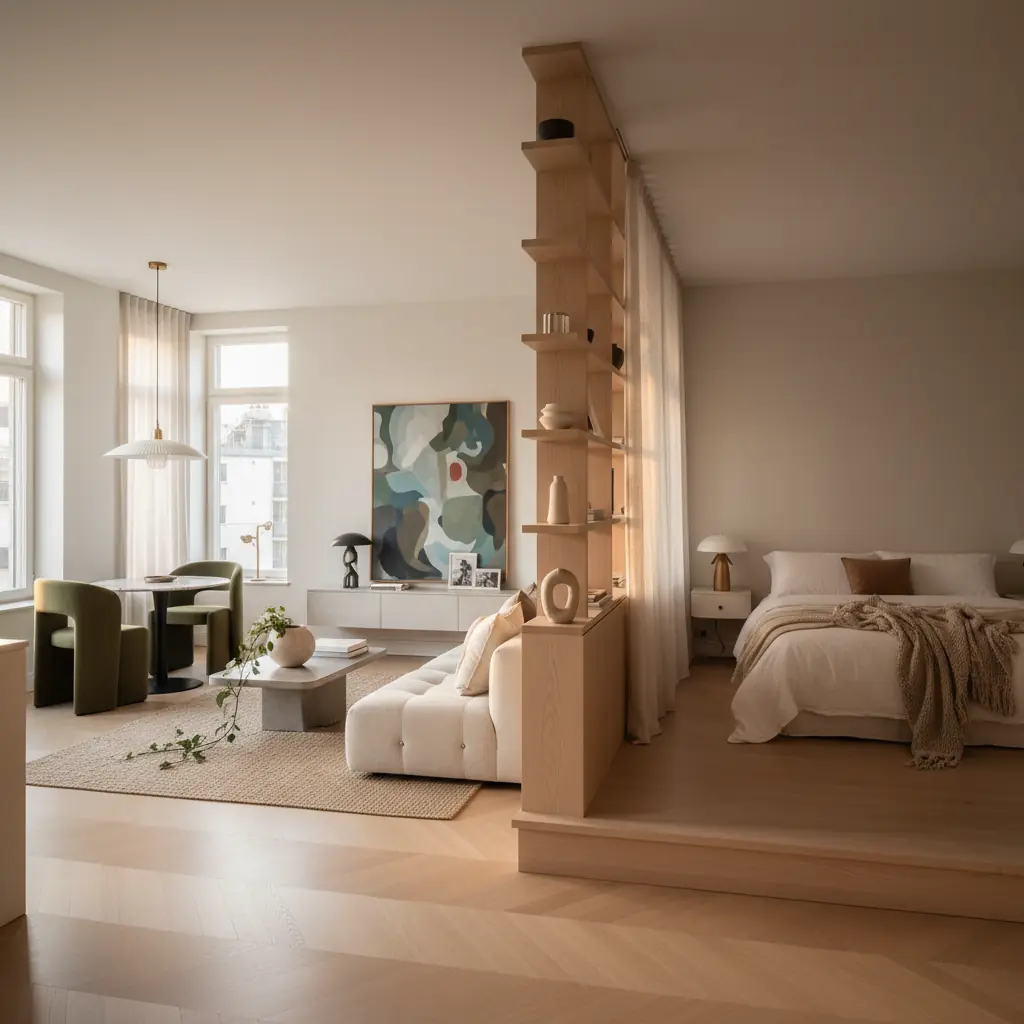
The Fundamental Challenge of One-Room Living: Creating Psychological Boundaries
A studio apartment, by its very nature, demands one room to fulfill many roles: a bedroom, living room, dining room, home office, and often a compact kitchen. The common impulse is to push all furniture against the walls, leaving the center open. While seemingly logical, this approach typically makes the space feel like a stark dorm room rather than a cohesive, comfortable home. It often leads to an undifferentiated, uninviting environment.
The opposite strategy yields far superior results: pull furniture away from walls, create intentional zones, and give each area a distinct purpose. A well-zoned 400-square-foot studio can feel significantly more livable and spacious than an unzoned 600-square-foot one, purely because of the psychological organization it provides.
The key insight here is that zones do not require physical walls to feel separate and purposeful. A subtle change in floor covering (like a rug), a variation in lighting, a shift in floor level (though less common in studios), or a thoughtful orientation of furniture is often enough for the brain to register a transition between distinct spaces. You are not physically dividing the room in a rigid sense; instead, you are creating psychological boundaries that make the space feel intentional, organized, and serene, rather than chaotic or claustrophobic. Research suggests that a well-organized and clearly zoned living space can significantly reduce stress levels and improve overall well-being.
Before you arrange a single piece of furniture, take stock of your non-negotiable daily activities: sleeping, cooking, working from home, entertaining, exercising, or dining. Rank these activities by importance and frequency. Your most important and frequently performed activities should receive the best real estate within your studio – think natural light, the most spacious area, or closest proximity to power outlets. Less frequent activities, or those requiring less dedicated space, can be relegated to corners or leftover areas. This strategic priority system is crucial for preventing the common mistake of allocating equal space to every activity, which inevitably leads to zones that are all slightly too small and functionally awkward.
The Bed Placement Dilemma: Where to Anchor Your Studio?
Where you place the bed is arguably the most critical decision in a studio layout, as it's typically the largest piece of furniture and the one you interact with most intimately. Its position dictates the flow and functionality of everything else. There are three primary strategies, each with its unique trade-offs.
### 1. Bed Against the Back Wall: The Traditional Retreat
Placing the bed against the studio's furthest wall, facing the entrance, is the most traditional layout. This strategy works exceptionally well when your studio has a clear "front" (entryway, kitchen, living space) and "back" (sleeping, quiet zone). It gives the bed a natural sense of privacy and separation from the more active, public zones of the apartment.
- **Pros:** Creates a clear visual hierarchy, often makes the sleeping area feel like a private sanctuary. Offers a defined backdrop for the bed, allowing for decorative headboards or wall art to become a focal point. - **Cons:** Can sometimes make the living area feel cramped if the studio is particularly narrow. May not be ideal if the "back wall" lacks natural light. - **Tip:** Ensure adequate walking space around the bed, especially if it’s a queen or king. Aim for at least 24 inches on the sides and foot, if possible, to allow for comfortable movement. A bed positioned this way anchors the private zone, allowing the rest of the apartment to function more openly.
### 2. Bed in a Corner with a Room Divider: A "Room Within a Room"
To create a more distinct separation, position your bed in a corner and introduce a room divider. This transforms the sleeping area into a "room within a room." Dividers can range from a tall, open bookshelf (ideally 72-80 inches high and at least 30 inches deep to provide substantial visual blockage) to a simple curtain on a ceiling-mounted track, or even an elegant folding screen.
- **IKEA KALLAX shelves** (particularly the 5x5 configuration, roughly 72x72 inches) are incredibly popular for this strategy. They function effectively as both a visual divider and valuable storage, with compartments accessible from both sides. You can fill them with books, decorative objects, or storage baskets to hide clutter, further enhancing the sense of a distinct space. - **Curtains** offer unparalleled flexibility. Ceiling-mounted tracks are key here; they look cleaner and more integrated than tension rods. You can pull curtains closed for complete visual privacy (essential when sleeping or hosting guests) and easily open them to restore the full studio footprint when desired. For more ideas on how to transform your space, Habitas can help you [visualize these changes on your actual room photo](/blog/ai-furniture-arrangement-tool) before committing to a style or purchase. - **Folding screens** are portable and decorative, offering a lighter touch than solid shelves. - **Pros:** Maximizes privacy, especially in smaller studios. Offers additional storage or display space (with shelves). Flexible options for light and visual blockage. - **Cons:** Can block some natural light depending on the divider type. Requires careful placement to ensure proper airflow.
### 3. Loft Bed: Elevating Space and Functionality
If your studio boasts generous ceiling height – at least 9 feet (2.7 meters) – a loft bed is an ingenious solution. Elevating the sleeping area frees up the entire footprint underneath, allowing you to dedicate that space to a desk, a cozy sofa, a mini-wardrobe, or even a small dining nook.
- **Considerations for Ceiling Height:** While a loft bed is technically possible with an 8-foot (2.4 meter) ceiling, it often feels uncomfortable. You'd typically have only 30-36 inches (76-91 cm) of clearance between the mattress and the ceiling, which can feel claustrophobic for most adults. For true comfort and utility, greater clearance is highly recommended. - **Pros:** Maximizes usable floor space dramatically, making a small studio feel much larger during the day. Creates a truly distinct sleeping "level." - **Cons:** Requires a comfortable and safe ladder or stairs. Can be challenging for those with mobility issues or a fear of heights. Can feel disconnected from the rest of the apartment. Installation can be complex and expensive if not purchased as a ready-made unit. - **Tip:** For urban studios, where the average size of new units has shrunk to around 500-550 square feet, loft beds are becoming an increasingly popular strategy, allowing residents to gain valuable square footage without a costly renovation.
Creating Zones with Rugs and Lighting: The Unsung Heroes
Rugs and lighting are arguably the simplest yet most effective tools for defining zones in a studio apartment. They work in tandem to create visual and psychological divisions without the need for any structural changes.
### How Rugs Anchor Your Spaces
Rugs are immediate zone-definers. A strategically placed rug instantly creates a visual island that grounds the furniture resting upon it and subtly separates it from adjacent areas.
- **Living Area:** A 5x7 or 6x9 rug placed under your sofa and coffee table immediately communicates "this is the living room." The rug should be large enough so that at least the front two legs of your main furniture (sofa, armchairs) rest upon it, unifying the seating arrangement. - **Office Nook:** A smaller rug, such as a 3x5 or 4x6, under a desk or in a dedicated corner clearly demarcates "this is the office." This is especially helpful if your workspace is in close proximity to your sleeping or living area. - **Sleeping Zone:** In the bedroom area, a large rug can extend from the foot of the bed, or you might opt for a runner on each side of the bed. This adds warmth and softness, making the sleeping zone feel distinct and cozy. - **Beyond Definition:** Rugs also add texture, color, and can improve acoustics in a hard-floored studio, making the space feel warmer and more inviting. Layering smaller, textured rugs over a larger, neutral rug can also add depth and further delineate sub-zones within a larger area.
### Lighting: Activating and Deactivating Zones
Thoughtful lighting design is incredibly powerful for reinforcing zones. It allows you to "activate" specific areas while letting others recede into shadow, transforming the feel of your studio throughout the day and evening.
- **Ambient vs. Task vs. Accent Lighting:** - **Living Area:** Typically benefits from a floor lamp (ambient light), a table lamp (task lighting for reading, or accent lighting for mood), and perhaps an art light to highlight a focal point. - **Bedroom Zone:** Should feature softer, warmer lighting. Bedside sconces, small table lamps with warm shades, or even dimmable pendant lights can create a tranquil atmosphere. Using smart lighting systems with color temperature control can allow you to shift from cool, energizing light to warm, relaxing light with a tap. - **Desk/Work Zone:** A dedicated task lamp is essential for focused work, preventing eye strain. Position it to illuminate your workspace directly. - **The Power of Dimmers:** Installing dimmers on all your light sources provides unparalleled control over ambiance. When you turn on only the living room lights and dim the bedroom zone, for example, the studio psychologically transforms into a living room – the darkened bed area gracefully fades from awareness. - **Avoid Uniform Overhead Lighting:** A common mistake is relying solely on a single overhead ceiling fixture. This washes the entire studio in uniform light, flattening all your carefully defined zones and making the room feel like one undifferentiated box. Instead, use multiple light sources at different heights and positions to create pockets of light and shadow that define spaces as effectively as physical walls.
Furniture as Room Dividers: Smart Multi-Functional Solutions
Your existing furniture pieces are often your most effective and cost-efficient room dividers. The trick is to rethink their placement and leverage their inherent structure to create visual separation.
### The Versatility of the Sofa
Your sofa is perhaps the best room divider you own – yet many people position it incorrectly in a studio. Instead of pushing it against a wall, float it in the middle of the studio. Orient its back towards the bed area and its front towards your designated living zone (perhaps facing a TV, a bookshelf, or a window). The sofa's back acts as a natural visual barrier between sleeping and living areas without blocking precious natural light or airflow.
- **Enhancing the Divide:** A console table placed behind the sofa (against its back) further reinforces this separation. It also provides a practical surface for lamps, decorative objects, or even a charging station, adding function and style to both zones. Modular sofas with chaises or L-shaped configurations can also be excellent for carving out a distinct lounge area.
### Open Bookshelves: Separation with Light
Open bookshelves are ideal dividers because they provide visual separation while still allowing light to pass through. A shelf unit that is 60-80% full (leaving some open gaps) lets natural light filter from one zone to another, preventing either area from feeling entirely cut off or dark.
- **Strategic Placement:** Solid room dividers, such as wardrobes or tall dressers, block more light but offer significant storage. Use these where blocking light is acceptable – for instance, between the sleeping zone and a windowless wall, or to create a pseudo-walk-in closet. Reserve open dividers for areas where light flow is crucial, like between the bed and a window. - **Beyond Books:** These shelves can hold plants, artwork, and decorative items that contribute to the aesthetic of both adjacent zones. This is a budget-friendly way to achieve a custom look; a good-quality modular bookshelf system can start from $200, a fraction of the cost of a built-in wall.
### Curtain Tracks: The Ultimate Flexible Divider
Ceiling-mounted curtain tracks offer the most flexible and adaptable division solution. Unlike tension rods, ceiling tracks provide a clean, integrated look and can even follow curved or L-shaped paths, giving you highly versatile division options.
- **Material Choices:** Use sheer curtains for subtle separation that maximizes light, or opt for heavier, opaque fabrics for complete visual and even some acoustic privacy. Blackout curtains are excellent for the sleeping zone. - **Habitas Advantage:** Visualizing these flexible dividers can be tricky. Tools like Habitas allow you to upload your studio photo and test various divider placements – from bookshelf arrangements to curtain tracks and specific furniture orientations – helping you find the perfect layout before you start moving heavy furniture or investing in new pieces. This iterative process, which takes seconds with AI, traditionally took days or weeks with physical mock-ups or expensive 3D rendering software.
The Work-From-Home Zone: Essential for Productivity
In an era of remote work, a dedicated work zone is a non-negotiable feature for many studio dwellers. Even within a single room, creating this separation is vital for productivity and mental well-being.
### Minimum Footprint and Smart Placement
The minimum functional footprint for a comfortable desk setup typically requires about 24x48 inches (60x120 cm) for the desk itself, plus at least 36 inches (90 cm) of clearance behind the chair for comfortable rolling back and movement. This totals approximately 24 square feet (2.2 square meters). This compact zone can fit efficiently against a wall, neatly tucked into a corner, or even positioned perpendicular to a window.
The most effective desk placement in a studio is often facing a wall or a window – never facing the bed or main living area. When your back is to the rest of the studio while you're working, you are psychologically "in the office." When you turn around, you are "home." This mental separation, subtle as it may seem, is surprisingly powerful in reducing the feeling that you constantly live at your workplace and can boost productivity by up to 20%.
### Maximizing Space with Fold-Down Desks
If space is at an absolute premium, a wall-mounted fold-down desk (often called a Murphy desk) is an ingenious solution. It provides a full, ergonomic work surface when needed and folds flat against the wall when not in use. A typical fold-down desk of 30x24 inches (76x60 cm) occupies only about 5 square feet of wall space and zero floor space when folded away. Pair it with a lightweight, foldable stool that tucks underneath or hangs on a wall hook, and your entire home office can disappear at the end of the workday, reclaiming your studio for leisure.
### Ergonomics and Technology Integration
Don't overlook ergonomics, even in a small space. Invest in a comfortable, supportive chair if you spend hours at your desk. Consider a monitor arm to elevate your screen and free up desk space. Cable management is also crucial; use cable clips, ties, and discreet organizers to keep your workspace looking tidy and professional. A clean, organized workspace contributes directly to a clear, focused mind.
Storage Solutions: Every Inch Counts
In a studio apartment, storage isn't just about tidiness; it's about maximizing every vertical and horizontal inch. Every piece of furniture should either contain storage or actively enable it.
### Multi-Functional Furniture: The Studio Apartment's Best Friend
- **Under-Bed Storage:** Beds with built-in drawers underneath or those designed with hydraulic lifts to access storage beneath the mattress can recover a significant 15-20 cubic feet of storage. This space would otherwise be dead space, collecting dust. These are perfect for linens, seasonal clothing, or less-frequently used items. - **Storage Ottomans:** These versatile pieces serve multiple purposes: extra seating, a comfortable footrest, a convenient coffee table (especially with a tray on top), and hidden storage for blankets, books, or remotes. - **Coffee Tables with Storage:** Look for coffee tables with drawers, lift-tops, or open shelving to store magazines, coasters, or small electronics.
### Vertical Storage: Unlocking Hidden Potential
- **Wall-Mounted Shelves:** Utilize the often-overlooked vertical space above doorways, windows, and even the television. Floating shelves or modular shelving systems can accommodate books, decor, or even kitchen overflow without taking up precious floor space. - **Tall, Narrow Units:** Slim tower units or pantry cabinets can fit into awkward nooks and provide substantial vertical storage for anything from cleaning supplies to pantry items. - **Pegboards and Wall Organizers:** In a kitchen or work zone, a wall-mounted pegboard can keep essential tools and utensils organized and accessible, freeing up drawer and counter space. - **Ceiling-Height Cabinets:** If you're undertaking a more significant renovation (or have very tall ceilings), custom built-in cabinetry that extends all the way to the ceiling provides maximum storage capacity and a seamless, integrated look. This can be a worthwhile investment; studies have shown that good storage and organization are top priorities for 60% of renters and homebuyers in smaller spaces.
Using Color, Texture, and Artwork to Define Zones
Beyond physical dividers, subtle aesthetic choices can profoundly influence how a studio feels zoned. Color, texture, and artwork are powerful psychological tools that reinforce your layout strategy.
### Color Palettes for Defined Zones
- **Accent Walls:** A painted accent wall in your sleeping zone, perhaps in a calming darker hue, instantly sets it apart from the brighter, more active living area. This creates a visual "hug" around the bed, making it feel more enclosed and intimate. - **Cohesive vs. Contrasting:** You can maintain a generally cohesive, lighter color palette throughout the entire studio to ensure flow, then introduce pops of color in each zone through soft furnishings (throw pillows, blankets, rugs) that subtly delineate areas. Alternatively, you can use slightly contrasting, but complementary, paint shades on adjacent walls to denote different functions without a stark division. [Using an AI color palette generator](/blog/ai-color-palette-generator) can help you explore harmonious combinations tailored to your space.
### Textural Play for Sensory Distinction
- **Rugs and Fabrics:** As mentioned, rugs are excellent. Beyond their visual role, their texture contributes to the sensory experience. A plush shag rug in the living area feels different from a flat-weave rug in the dining nook or a soft cotton rug by the bed. - **Furniture Materials:** Mix and match materials to define zones. A sleek, modern sofa in the living area, a rustic wooden desk in the office nook, and soft, upholstered pieces in the bedroom can each signal a different function. - **Wall Treatments:** Consider a textured wallpaper or even wood paneling on one wall within a specific zone (e.g., behind the bed) to add depth and a distinct character.
### Artwork as Anchors and Focal Points
- **Gallery Walls:** A curated gallery wall in the living area immediately designates it as a social and decorative space. - **Large-Scale Art:** A single, large piece of artwork above the sofa or bed can serve as a powerful focal point, drawing the eye and anchoring that specific zone. - **Mirrors:** Strategically placed mirrors can not only reflect light and make a small space feel larger, but they can also visually expand a zone. For example, a large mirror behind a dining table can make that area feel more expansive and grand.
Real Studio Layout Examples: Making It Tangible
Let's look at how these strategies come together in actual studio layouts of varying sizes.
### A 400-Square-Foot Studio: Balancing Four Zones
Consider a typical rectangular 400-square-foot (37 sq m) studio.
1. **Entry/Kitchen Zone:** You might enter directly into a compact kitchen area, typically lining one wall (8-10 feet of counter and cabinets). A small drop-leaf dining table could be integrated here, folding away when not in use. 2. **Living Zone:** Past the kitchen, a 5x7 or 6x9 rug defines the living area. A three-seater sofa floats perpendicular to the wall, its back creating the primary visual divider. A sleek, wall-mounted TV or a low media console faces the sofa. 3. **Sleeping Zone:** Behind the sofa, the bed sits against the far wall with compact nightstands or floating shelves on each side. A ceiling-mounted curtain track could be installed just behind the sofa, offering full privacy when drawn. 4. **Work Zone:** A dedicated desk occupies a corner by the window, placed perpendicular to the glass. This provides natural light and an inspiring view while working, keeping the worker's back to the rest of the apartment. 5. **Storage:** A wardrobe or closet system lines the wall near the entry, utilizing vertical space. Under-bed storage and a console table behind the sofa provide additional spots.
This layout achieves four distinct zones (kitchen/dining, living, sleeping, work) within a single room, each with clear boundaries established through furniture placement, rugs, and varying light sources.
### A 300-Square-Foot Studio: Ruthless Prioritization
For a truly compact 300-square-foot (28 sq m) studio, prioritization must be ruthless.
1. **Bed & Work Share a Zone:** The bed is placed against the longest wall. Instead of a separate desk, a compact, wall-mounted floating desk (24x36 inches) is installed at the foot of the bed, perhaps facing a window or a carefully curated gallery wall for visual interest. A small, ergonomic stool tucks neatly underneath. 2. **Compact Sitting Zone:** The sofa might be replaced with two comfortable, small-scale armchairs or a loveseat that take up less visual and physical space but still define a "sitting" zone. A small, round coffee table with storage would anchor this area. 3. **Kitchen/Dining:** The kitchen remains a one-wall layout, potentially with a pull-out counter extension for dining or prep. 4. **Every Surface Does Double Duty:** Storage ottomans, a narrow console table by the entry for keys, and wall-mounted shelves become essential. All clothing would likely be in a tall, narrow wardrobe or a well-organized closet system.
These tight layouts benefit enormously from AI visualization tools. Habitas allows you to test multiple arrangements without physically moving a single piece of furniture. In a 300-square-foot space, this means you can iterate through dozens of ideas in minutes, rather than spending a full day rearranging, only to find the layout doesn't quite work. This efficiency saves time, energy, and potential frustration, ensuring you create a space that feels tailor-made for your lifestyle.
Frequently Asked Questions
### How do I make my studio apartment feel bigger than it is?
To make your studio apartment feel larger, focus on visual tricks and smart organization. Use light, neutral color palettes, especially on walls, to create an expansive backdrop. Incorporate mirrors strategically to reflect light and views, effectively doubling the perceived space. Opt for multi-functional furniture (like storage ottomans or a sofa bed) and pieces with slim profiles or exposed legs to maintain an airy feel. Maximize vertical storage to keep clutter off the floor, and use consistent flooring throughout to avoid visual breaks that chop up the space. Thoughtful lighting, with multiple sources and dimmers, can also create depth.
### What are the best furniture pieces for a studio apartment?
The best furniture for a studio apartment is multi-functional, scaled appropriately, and offers clever storage. Key pieces include: a sofa bed or a sofa that floats to define zones, a storage ottoman or coffee table with built-in storage, a wall-mounted or fold-down desk for a discreet work zone, and open bookshelves or modular shelving units that can serve as both storage and room dividers. Beds with under-bed drawers or lift-up storage are also invaluable. Prioritize items that can serve at least two purposes to maximize efficiency.
### How can I get privacy in a studio apartment?
Achieving privacy in a studio apartment involves visual and acoustic strategies. The most effective method is using physical dividers like ceiling-mounted curtains (heavy fabric for visual and some acoustic privacy), tall open bookshelves (like IKEA KALLAX), or elegant folding screens. Strategically floating furniture, such as placing the back of a sofa towards your bed, also creates a psychological barrier. For sound privacy, consider adding rugs, upholstered furniture, and sound-absorbing artwork. For light control and visual privacy from outside, invest in blackout blinds or curtains.
### Is it hard to live in a studio apartment?
Living in a studio apartment can be challenging for some due to the limited space and the constant need for organization and intentional design. However, it's also highly rewarding for others, offering advantages like lower rent, reduced utility bills, and a simplified lifestyle. The key to successful studio living lies in effective zoning, ruthless decluttering, and embracing multi-functional solutions. With a well-thought-out layout and smart design choices, a studio can feel surprisingly spacious and incredibly cozy, making it a comfortable and efficient home.
### How much does it cost to furnish a studio apartment stylishly?
The cost to furnish a studio apartment stylishly can vary widely, from budget-friendly options to high-end designs. For a functional and aesthetically pleasing setup, you might expect to spend anywhere from **$2,000 to $7,000** for new essential furniture (bed, sofa, desk, storage). This budget allows for a mix of IKEA, Target, or Wayfair finds with a few slightly more substantial pieces. If you incorporate custom solutions, designer pieces, or higher-quality materials, costs can easily exceed **$10,000 to $15,000**. Thrifting, DIY projects, and leveraging AI design tools like Habitas to visualize and plan can help you achieve a stylish look on a more modest budget.