What is Biomorphic Futurism? The 2026 Interior Design Trend Defined
Explore the rise of Biomorphic Futurism in 2026, where organic shapes meet high-tech innovation to create the next generation of fluid, sustainable interiors.
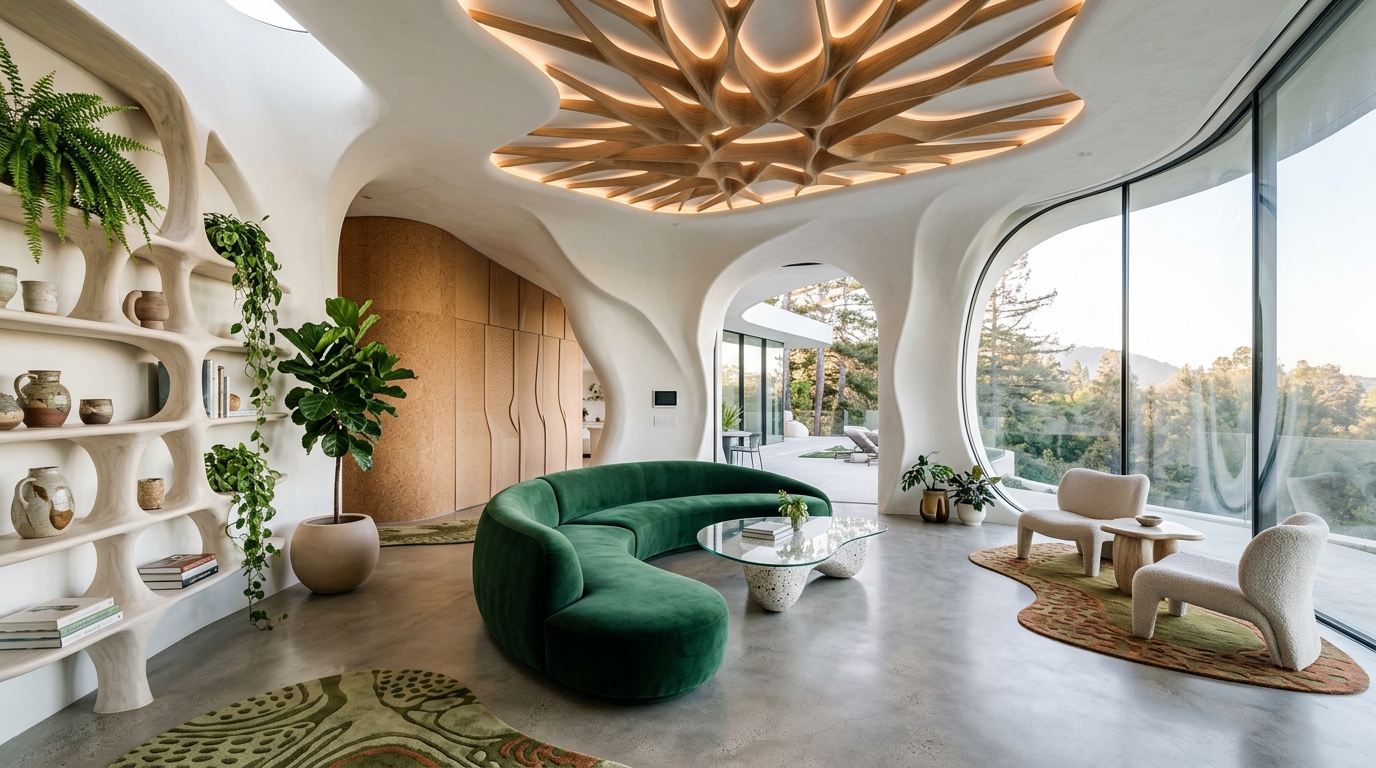
What Exactly is Biomorphic Futurism?
At its core, Biomorphic Futurism is the design philosophy of creating interior spaces and objects that mimic the patterns, shapes, and functional systems found in nature, enhanced by futuristic technology. While "biomorphic" design has existed since the mid-20th century, the "futurism" component of 2026 relies on advanced manufacturing techniques like large-scale 3D printing and AI-driven structural optimization.
In a biomorphic futuristic home, you won’t find sharp 90-degree corners or static, heavy furniture. Instead, you see walls that flow into ceilings, chairs that resemble skeletal structures or blooming flora, and lighting systems that pulse like bioluminescent deep-sea creatures. It is a synthesis of the "soft" (biological) and the "hard" (technological).
The Evolution: From Mid-Century Modern to Organic High-Tech
To understand where we are in 2026, we have to look back. The trend began as an evolution of "Soft Minimalism." People grew tired of the clinical coldness of ultra-modernism and sought comfort. However, the rise of [ai-generated room designs (realistic)](/blog/ai-generated-room-designs-realistic) allowed designers to experiment with complex geometries that were previously impossible to calculate or build.
In 2024 and 2025, we saw the preliminary stages of this movement through the resurgence of "curvy furniture." In 2026, these curves have become structural. According to recent industry reports, the market for 3D-printed interior components has seen a CAGR of 24.5% since 2023, reaching an estimated value of $1.8 billion this year. This technological accessibility is what differentiates today's biomorphism from the experimental sketches of the 1960s.
Why 2026 is the Year of the Curve
The primary driver behind this trend is a psychological need for reconnection. After a decade of high-screen-time living, homeowners are craving environments that feel "alive." Biomorphic Futurism leverages the concept of biophilia—our innate human connection to nature—but updates it for a digital age.
We are no longer just putting plants in a room; we are making the room behave like a plant. Advanced platforms like Habitas allow users to visualize these fluid spaces in real-time, using generative algorithms to find the perfect balance between structural integrity and organic beauty. By using an [ai-interior-design-how-it-works](/blog/ai-interior-design-how-it-works) approach, we can now simulate how light flows over curved surfaces before a single piece of material is sourced.
Key Characteristics of Biomorphic Futurism
If you are looking to identify or implement this style, look for these five defining pillars:
### 1. Generative fluid geometries
The most striking feature is the lack of straight lines. Walls may ripple like water, and kitchen islands might resemble smoothed river stones. These aren't just random curves; they are often "generative," meaning an AI algorithm designed the shape to be as material-efficient as possible.
### 2. Adaptive bioluminescent lighting
Forget static LED strips. 2026 is about [ai-driven-biometric-lighting-for-mental-wellness](/blog/ai-driven-biometric-lighting-for-mental-wellness). These systems use sensors to track your circadian rhythm, but the fixtures themselves are shaped like crystalline growths or glowing fungi, casting soft, diffused light that feels natural rather than artificial.
### 3. Tactile, "Living" Materials
Textiles in this trend are highly advanced. We are seeing a massive shift toward [3d-knit-textiles-vs-traditional-upholstery](/blog/3d-knit-textiles-vs-traditional-upholstery), where furniture covers are knitted in a single piece to fit complex organic shapes perfectly, reducing waste by up to 30% compared to traditional cutting and sewing.
### 4. Mycelium and Bio-polymers
Sustainability is baked into the "futurism" aspect. Designers are utilizing mushroom-based "leather" and 3D-printed bio-plastics derived from corn and algae. The goal is a home that could theoretically decompose back into the earth after its lifecycle.
### 5. Seamless Integration of Tech
The technology in these homes is "calm tech." It is hidden within the curves. Voice assistants are embedded behind acoustic fabrics, and climate control is handled by "breathing" walls that regulate humidity through porous, coral-inspired structures.
How AI is Powering the Organic Revolution
The complexity of biomorphic shapes makes them difficult for traditional human drafting. A human architect might take weeks to calculate the load-bearing capacity of a vaulted, bone-like ceiling. An AI can do it in seconds.
Using an [ai-image-to-3d-model-comparison](/blog/ai-image-to-3d-model-comparison) workflow, designers can now take a photo of a leaf or a piece of driftwood and instantly transform its mathematical patterns into a functional piece of furniture. This has reduced the design-to-production timeline by approximately 60%, allowing for bespoke, organic homes to be built at a fraction of the previous cost.
In 2026, the average cost of a custom AI-designed biomorphic coffee table has dropped from $4,000 (in 2023) to roughly $1,100, thanks to the optimization of local 3D printing hubs.
The Role of 3D Printing and Additive Manufacturing
You cannot have Biomorphic Futurism without 3D printing. Traditional manufacturing relies on subtraction (cutting pieces away) or molding (which requires expensive, rigid forms). 3D printing is additive, meaning it only places material where it is needed.
This allows for "topological optimization"—a fancy way of saying we can make objects that are incredibly strong but look as delicate as a dragonfly’s wing. We are seeing this most prominently in wall treatments. For instance, [3d-printed-acoustic-panel-trends-2026](/blog/3d-printed-acoustic-panel-trends-2026) show a move toward panels that look like cellular structures, which happen to be 40% more effective at dampening sound than flat foam panels.
Is Biomorphic Futurism Expensive to Implement?
There is a common misconception that futuristic design is only for the ultra-wealthy. While high-end bespoke projects still command a premium, the democratization of AI tools through platforms like Habitas has made this aesthetic accessible to the mid-market.
- **Bespoke AI Design:** $2,000 - $5,000 (Design fees only) - **3D Printed Bio-polymer Chair:** $600 - $1,200 - **Modular Biomorphic Wall Panels:** $40 per square foot
When compared to traditional high-end custom woodworking, biomorphic 3D-printed alternatives are often 20-30% cheaper because they require significantly less manual labor. The "intelligence" is in the file, not the hands-on carving.
How to Start Transitioning Your Space
You don't need to tear down your house to embrace Biomorphic Futurism. Start with the "Fluid Accents" approach:
1. **Introduce Asymmetry:** Replace a pair of matching square end tables with a single, larger organic-shaped piece. 2. **Focus on "The Fifth Wall":** Use 3D-printed ceiling medallions or light fixtures that spill over onto the walls. 3. **Update Your Textures:** Move away from flat linens toward 3D-knit fabrics with "topographical" depth. 4. **Use Generative Tools:** Use an AI tool to see how your current room would look with curved interventions. This helps prevent the "clutter" look that often happens when mixing styles.
The Impact on Mental Health and Wellness
Design experts in 2026 are focused heavily on "Neuro-Aesthetics." Studies have shown that viewing sharp angles triggers a slight fear response in the amygdala, whereas viewing curved, organic shapes promotes the release of oxytocin and reduces cortisol levels.
By living in a Biomorphic Futurist environment, residents report a 15% increase in perceived well-being and a 10% increase in creative productivity. The space acts as a sensory "buffer" against the frenetic pace of the outside world. This is why we are seeing this trend explode in home offices and "sanctuary" bedrooms.
The Future of the Trend: What’s Next?
By 2030, we expect Biomorphic Futurism to evolve into "Bio-Digital Architecture," where the materials in our homes are actually alive—think algae-filled glass panels that produce oxygen or furniture grown from living root systems.
For now, 2026 is the "Sweet Spot." We have the technology to create the beauty of nature without the maintenance of a literal living forest in our living room. It is a time of soft edges, smart lights, and spaces that finally feel like they were made for humans, by humans (with a little help from our silicon friends).
People Also Ask (FAQ)
### What is the difference between Biophilic Design and Biomorphic Futurism?
Biophilic design focuses on bringing actual nature (plants, light, water) into a space. Biomorphic Futurism focuses on the _shapes and systems_ of nature, recreated through high-tech materials and AI design. One is about "having" nature; the other is about "becoming" natural in form.
### Is biomorphic furniture comfortable?
Yes. Because biomorphic furniture is often designed using "ergonomic generative modeling," it is frequently more comfortable than traditional furniture. These pieces are shaped to follow the natural contours of the human body, similar to how a nest or a hollowed-out stone might feel.
### Can I use Biomorphic Futurism in a small apartment?
Absolutely. In fact, the fluid lines of this trend can make small spaces feel larger because there are no harsh "breaks" for the eye. A curved wall or a floating, organic desk can create a sense of continuous flow that makes a cramped room feel more expansive.
### How do I clean 3D-printed biomorphic surfaces?
Most 2026 bio-polymers are treated with nano-coatings that make them dust-repellent and non-porous. Unlike traditional wood or fabric, these surfaces can usually be cleaned with a simple damp micro-fiber cloth.
### Does this trend work with traditional decor?
It works best as a "statement" contrast. Placing a biomorphic, 3D-printed chair in a room with traditional crown molding creates a "time-travel" aesthetic that is very popular in 2026. However, it is usually best to pick one or two focal points rather than mixing too many competing styles.
Final Thoughts
Biomorphic Futurism represents the maturing of the AI-design era. We have moved past the novelty of "look what AI can do" and into the functional reality of "look how AI can make us feel." By embracing the fluid, the organic, and the technological, we are creating homes that are not just shelters, but ecosystems designed for the modern soul.
Whether you are looking to completely redesign your home or just add a touch of the future to your living room, the tools are now at your fingertips. Platforms like Habitas are leading the way, ensuring that the transition from a box-like past to a fluid future is seamless, sustainable, and undeniably beautiful.