Dominando layouts de cômodos desafiadores: Soluções de especialistas para espaços em L, angulares e de formato incomum
Transforme cômodos desafiadores em L, angulares ou com múltiplas portas em espaços funcionais e belos. Descubra layouts de móveis, estratégias de zoneamento e dicas de design impulsionadas por IA.
Por que cômodos desafiadores são, na verdade, oportunidades de design
Um cômodo perfeitamente retangular oferece uma tela em branco, o que, paradoxalmente, pode ser mais difícil de tornar verdadeiramente único. Cômodos desafiadores – sejam em forma de L, com ângulos agudos, nichos inesperados ou espaços repletos de cinco portas – não apenas _permitem_ soluções criativas, eles as _exigem_. E, muitas vezes, essas inovações forçadas levam a espaços muito mais distintivos e cheios de personalidade do que seus equivalentes retilíneos. O segredo não é lutar contra as peculiaridades do cômodo, mas abraçá-las e realçá-las. Cada ângulo ímpar é um potencial cantinho de leitura. Cada nicho é um convite para um móvel embutido sob medida. Cada curva em L é um limite de zona natural esperando para ser definido.
A jornada para transformar um cômodo desafiador começa com precisão. Antes de mover um único móvel, crie uma planta baixa precisa. Esboce a forma do cômodo no papel, use uma fita métrica ou aproveite uma sofisticada [ferramenta de arranjo de móveis com IA](/blog/ai-furniture-arrangement-tool) que pode mapear seu espaço. Anote todas as dimensões: comprimentos das paredes, ângulos dos cantos, profundidades dos nichos, folgas cruciais para o giro das portas e posicionamento das janelas. A maior parte da frustração com layouts vem de tentar forçar móveis padrão em espaços não padrão. Conhecer suas dimensões exatas antecipadamente evita o erro caro de comprar um sofá que bloqueia uma porta ou uma mesa de jantar que simplesmente não cabe em um cantinho apertado. Estudos mostram que mais de 40% dos reformadores de casas se arrependem de pelo menos uma compra de móveis devido ao tamanho ou encaixe inadequados, destacando a importância de um planejamento meticuloso.
Cômodos em L: definindo duas zonas em um só espaço
Um cômodo em L é, em sua essência, dois retângulos unidos em um canto. A estratégia de design mais eficaz é tratá-lo precisamente como tal: duas zonas distintas e intencionais. O retângulo maior tipicamente se torna a área funcional primária, mais comumente uma sala de estar ou uma espaçosa área de jantar. O retângulo menor, então, se presta perfeitamente a uma zona secundária – talvez um aconchegante cantinho de leitura, um produtivo **home office**, uma área de brincadeiras dedicada para crianças, um sofisticado bar doméstico ou até mesmo um canto de meditação.
Cada zona deve receber suas próprias sugestões visuais e identidade funcional. Isso significa seu próprio tapete de tamanho apropriado, sua própria camada de iluminação (talvez um pendente sobre a área de jantar e um abajur de chão no cantinho de leitura) e seu próprio agrupamento de móveis autocontido.
A "curva" do L é o ponto crítico de transição. Resista à tentação de colocar móveis grandes e volumosos diretamente neste canto, pois isso pode bloquear o fluxo visual e físico, fazendo com que o cômodo pareça fragmentado e obstruído. Em vez disso, mantenha a curva relativamente aberta, talvez com uma planta estrategicamente posicionada, um abajur de chão escultural ou uma mesa de apoio estreita que sinalize a transição sem impedir o movimento. Essa curva também é um local ideal para um móvel que serve a ambas as zonas: uma estante de livros dupla face que se volta para a área de estar de um lado e para o escritório do outro, ou uma elegante mesa console com uma luminária que fornece luz ambiente para ambos os espaços.
A orientação dos móveis é fundamental em espaços em L. Na zona principal, organize seu sofá e assentos para ficarem de frente um para o outro ou para um ponto focal claro (como uma lareira, uma janela grande ou um console de mídia) _sem_ fazer referência direta à curva do L. Da mesma forma, a zona secundária deve ter seu próprio foco interno – uma escrivaninha de frente para uma parede para concentração, uma mesa de jantar centrada em seu nicho. Quando cada zona parece autocontida e proposital, o cômodo como um todo se apresenta como duas áreas cuidadosamente projetadas, em vez de um espaço confuso e desorganizado.
Como transformar paredes angulares e nichos em características únicas
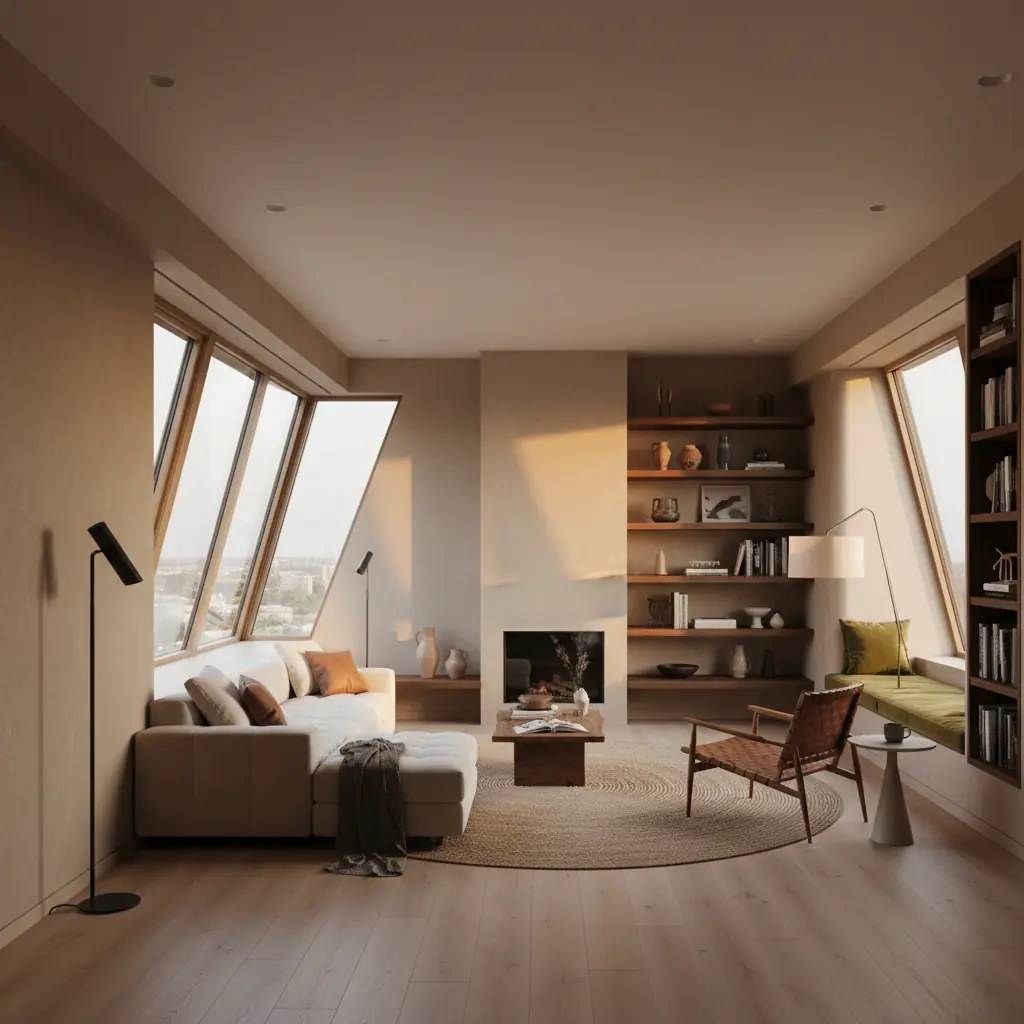
Paredes angulares, frequentemente encontradas em sótãos, apartamentos de canto ou edifícios mais antigos e cheios de personalidade, podem parecer um inimigo do **design** para móveis retangulares padrão. Encostar um sofá de encosto reto contra uma parede de 135 graus inevitavelmente deixa vãos triangulares estranhos e que acumulam poeira. As soluções mais elegantes envolvem ou afastar completamente os móveis das paredes angulares, criando um corredor intencional atrás, ou, de forma mais criativa, abraçar a própria parede angular como uma característica de **design**. Paredes angulares são inerentemente únicas e podem ser perfeitas para prateleiras embutidas personalizadas, um banco de janela sob medida (se houver uma janela) ou uma escrivaninha feita sob medida que siga precisamente a inclinação única da parede. Essa abordagem personalizada pode ser visualizada usando ferramentas como Habitas, que permite ver [designs de cômodos gerados por IA realistas](/blog/ai-room-designs-realistic) para seus ângulos específicos.
Nichos, reentrâncias muitas vezes esquecidas, são as joias escondidas de cômodos desafiadores. Mesmo um nicho modesto de 90 cm de profundidade pode se transformar em um **home office** altamente funcional; basta montar uma prateleira flutuante como escrivaninha, adicionar uma luminária de tarefa, e o nicho se torna um espaço de trabalho que se recolhe discretamente quando a cadeira é empurrada para dentro. Um nicho mais largo (1,20 a 1,50 metros) oferece espaço suficiente para um divã, um aconchegante cantinho de leitura completo com almofadas embutidas e prateleiras integradas, ou até mesmo uma mini-lavanderia na entrada. Mesmo nichos rasos (30 a 45 cm de profundidade) são valiosos, perfeitos para prateleiras de exibição, um nicho de bar elegante ou uma parede de galeria de arte que feels recessed and curated.
O maior erro que os **designers** veem é tratar os nichos como depósitos para móveis desajustados ou simplesmente ignorar seu potencial. A medição precisa é fundamental. Uma peça sob medida que preenche exatamente o nicho – seja um banco com armazenamento oculto, uma estante de parede a parede ou uma escrivaninha personalizada – transforma o espaço morto na parte mais cheia de personalidade e propósito do cômodo. Embora os móveis embutidos personalizados exijam um investimento inicial, muitas vezes variando de US$ 1.500 a US$ 5.000 por metro linear, dependendo dos materiais e da complexidade, eles aprimoram significativamente a funcionalidade e, de acordo com especialistas imobiliários, podem aumentar o valor percebido de uma casa em 5 a 10%, criando espaços sob medida e altamente funcionais.
O que fazer quando seu cômodo tem muitas portas e janelas?
Alguns cômodos apresentam um desafio significativo: quatro portas, três janelas e mal há espaço contínuo de parede para móveis. Este é um cenário comum em casas mais antigas, onde corredores, armários e cômodos adjacentes exigiam cada um sua própria porta. A primeira pergunta crucial a fazer é: todas essas portas _realmente_ precisam funcionar como portas de giro? Uma porta que leva a um armário raramente usado pode ser melhor servida por uma cortina elegante ou até mesmo um painel permanentemente fechado e vedado, recuperando efetivamente seu espaço de giro. Da mesma forma, uma porta entre dois cômodos que é raramente utilizada poderia ser permanentemente fechada ou substituída por uma alternativa mais eficiente em termos de espaço.
Para portas que devem permanecer funcionais, mapeie meticulosamente seus arcos de giro em sua planta baixa. O espaço dentro do arco de giro de uma porta é funcionalmente morto para o posicionamento de móveis. Uma vez que esses arcos são claramente marcados, o espaço útil restante no chão se torna aparente, e arranjos práticos de móveis muitas vezes emergem mais claramente. Para otimizar ainda mais o espaço, considere alternativas às portas de batente tradicionais. Portas de correr tipo "celeiro" ou portas de embutir eliminam completamente os arcos de giro, operando com folga zero, embora exijam modificações na parede para instalação. Portas camarão ou portas francesas também podem reduzir a pegada necessária em comparação com uma única porta de giro grande. Estudos indicam que até 30% do espaço útil da parede pode ser perdido em cômodos com três ou mais portas convencionais, tornando a gestão estratégica das portas crucial.
Com espaço limitado na parede, móveis flutuantes se tornam menos uma opção e mais uma necessidade. Um sofá posicionado centralmente no cômodo com suas costas para uma porta, uma mesa de jantar redonda que não exige ancoragem na parede, ou uma escrivaninha posicionada perpendicularmente à parede em vez de encostada a ela – todas essas são estratégias eficazes para cômodos com várias portas. Prateleiras montadas na parede, armários flutuantes e suportes de TV também ajudam a manter o espaço do chão livre, aproveitando ao máximo as estreitas faixas de parede disponíveis entre as aberturas. Para visualizar esses arranjos complexos, [aplicativos de design de interiores com IA comparados 2026](/blog/ai-interior-design-apps-compared-2026) podem oferecer assistência inestimável.
A técnica do móvel "flutuante": criando ordem a partir do caos
Móveis "flutuantes" – intencionalmente afastando as peças das paredes perimetrais – pode parecer contraintuitivo em um cômodo já desafiador, mas é frequentemente a solução mais elegante e eficaz. Quando os móveis se alinham rigidamente ao perímetro, cada irregularidade da parede (uma saliência, um ângulo, um nicho, uma porta) se torna um problema amplificado. No entanto, quando os móveis "flutuam" no centro, essas irregularidades perimetrais recuam para a arquitetura de fundo, e os próprios móveis criam sua própria geometria mais previsível no meio do cômodo.
Imagine uma sala de estar onde um sofá é afastado de 60 a 90 cm da parede principal, com uma mesa console ou até mesmo uma estante estreita colocada atrás dele. Ou uma mesa de jantar centralizada em um cômodo em L, em vez de empurrada para um canto. Até mesmo uma cama afastada 45 cm de uma parede pode criar uma sensação luxuosa de "estilo de hotel" com espaço para uma prateleira linear, iluminação oculta ou uma passagem atrás. Esses arranjos impõem ordem ao caos. O agrupamento de móveis se torna a geometria primária do cômodo, e as paredes reais se tornam um elemento secundário e de suporte. Esta é uma técnica marcante empregada por **designers** profissionais em showrooms de alto padrão e revistas: em vez de projetar _para_ as paredes, eles projetam _do_ centro para fora.
O espaço intencional criado entre os móveis "flutuantes" e as paredes também gera espaço extra. Essa lacuna de 30 cm atrás de um sofá "flutuante" pode se tornar um local discreto para uma mesa console estreita, uma estação de carregamento para dispositivos, ou até mesmo uma estante baixa e acessível. A passagem ao redor de uma cama "flutuante" transforma uma parede sem saída em um caminho funcional e bem pensado. Essa técnica pode sentir daunting para visualizar em um espaço real, mas ferramentas como Habitas são particularmente úteis para cômodos desafiadores porque você pode visualizar o posicionamento dos móveis antes de se comprometer. Basta carregar uma foto do seu cômodo e experimentar layouts "flutuantes" versus layouts encostados na parede para ver qual abordagem oferece à forma específica do seu cômodo o resultado mais funcional e visualmente equilibrado. Habitas permite que você experimente a [ferramenta de arranjo de móveis com IA](/blog/ai-furniture-arrangement-tool) virtualmente, economizando tempo e prevenindo erros caros.
Usando tapetes para impor geometria e definir zonas
Em um cômodo onde a estrutura arquitetônica não oferece uma geometria limpa e coesa, um tapete bem escolhido pode entrar em cena para cumprir a função. Um tapete grande e retangular, colocado centralmente em um cômodo em L ou angular, atua como uma poderosa âncora visual – um retângulo limpo e previsível que o olho usa como estrutura organizadora para todo o espaço. Móveis arranjados sobre e ao redor deste tapete são instantaneamente lidos como um agrupamento coerente, independentemente do que as paredes circundantes estão fazendo.
Tapetes em camadas oferecem outra maneira sofisticada de definir subzonas em cômodos de formato incomum. Um tapete base grande e neutro, cobrindo a maior parte do chão, estabelece a geometria geral e ancora a zona primária. Um tapete de destaque menor na zona secundária (talvez o braço curto de um L, um nicho ou um canto de jantar) então a marca claramente como uma área distinta e proposital. O tapete base neutro unifica o cômodo, enquanto o tapete de destaque sinaliza sutilmente: "esta área é diferente e tem sua própria função". Essa estratégia é especialmente eficaz em espaços de conceito aberto ou cenários de [orçamento de decoração de apartamento](/blog/apartment-decorating-budget).
A forma do tapete também desempenha um papel significativo. Em um cômodo dominado por ângulos acentuados ou cantos irregulares, um tapete redondo ou oval pode suavizar a geometria e desviar a atenção das linhas arquitetônicas desafiadoras. Em um cômodo em L, dois tapetes retangulares de tamanho apropriado – um para cada zona definida – podem reforçar efetivamente a estratégia de duas zonas. No entanto, evite tapetes muito pequenos. Um tapete que não se estende pelo menos sob as pernas dianteiras do seu sofá parecerá flutuando sem rumo no meio do cômodo, adicionando ao caos visual em vez de resolvê-lo. Para uma área de estar, o tapete deve ser idealmente grande o suficiente para que todos os móveis fiquem sobre ele, ou, no mínimo, todas as pernas dianteiras das peças principais de assento repousem confortavelmente sobre o tapete. Um tapete de tamanho adequado pode fazer um cômodo parecer 20% maior e mais coeso, criando um impacto significativo na percepção de amplitude e fluidez do **design**.
Perguntas Frequentes
### Como arranjar móveis em uma sala de estar em L?
Para uma sala de estar em L, a melhor estratégia é dividi-la em duas zonas distintas: uma primária e uma secundária. Posicione seus assentos principais (sofá, poltronas) no "braço" maior do L, orientando-os para um ponto focal como uma TV ou lareira, independentemente da forma geral de 'L' do cômodo. O "braço" menor pode então se tornar um cantinho de leitura, **home office** ou área de jantar. Use tapetes, iluminação e agrupamento interno de móveis para definir essas zonas, mantendo a "curva" do L livre para facilitar o fluxo.
### Quais são algumas soluções comuns para cômodos com paredes angulares?
Paredes angulares frequentemente apresentam oportunidades para móveis embutidos personalizados, como prateleiras, bancos de janela ou escrivaninhas que seguem a inclinação única da parede. Alternativamente, afaste os móveis da parede angular, criando um corredor intencional atrás dela. Isso evita vãos estranhos e permite que os móveis estabeleçam sua própria geometria retangular no centro do cômodo. Grandes espelhos ou arte alta e estreita também podem fazer com que as paredes angulares pareçam menos intrusivas.
### Como posso maximizar o espaço em um cômodo com muitas portas?
Para maximizar o espaço em um cômodo com múltiplas portas, primeiro avalie se todas as portas são essenciais ou se algumas podem ser substituídas por cortinas, vedadas ou alteradas para opções mais eficientes em termos de espaço, como portas de embutir, portas de correr tipo "celeiro" ou portas camarão. Mapeie todos os arcos de giro das portas, pois essas áreas são funcionalmente mortas para o posicionamento de móveis. Em seguida, adote arranjos de móveis "flutuantes" no centro do cômodo, usando prateleiras e TVs montadas na parede para liberar espaço no chão em seções de parede estreitas.
### É melhor afastar os móveis das paredes ou mantê-los encostados em um cômodo de formato incomum?
Na maioria dos cômodos de formato incomum, afastar os móveis das paredes (flutuá-los) é uma estratégia superior. Quando os móveis se alinham ao perímetro, cada irregularidade da parede se torna um problema. No entanto, móveis "flutuantes" criam suas próprias zonas e geometria definidas no centro do cômodo, fazendo com que as peculiaridades arquitetônicas das paredes recuem para o plano de fundo. Essa abordagem geralmente resulta em um espaço mais funcional, visualmente equilibrado e sofisticado.
### Que papel os tapetes desempenham na definição de zonas em espaços desafiadores?
Tapetes são ferramentas incrivelmente poderosas para definir zonas e impor geometria visual em espaços desafiadores. Um tapete grande e bem posicionado pode criar uma âncora clara e coerente para uma área de estar ou jantar primária, independentemente das formas das paredes ao redor. Tapetes em camadas podem delimitar ainda mais zonas secundárias, usando diferentes tamanhos, texturas ou padrões para marcar sutilmente áreas funcionais distintas dentro de um cômodo maior e de formato irregular. Sempre garanta que os tapetes sejam grandes o suficiente para acomodar confortavelmente pelo menos as pernas dianteiras das principais peças de mobiliário.
### Como as ferramentas de design de interiores com IA podem ajudar com layouts de cômodos desafiadores?
Ferramentas de **design** de interiores com IA como Habitas podem revolucionar a forma como você aborda layouts de cômodos desafiadores. Ao permitir que você carregue fotos ou dimensões do seu cômodo real, a IA pode gerar [designs de cômodos gerados por IA realistas](/blog/ai-generated-room-designs-realistic) para o seu espaço, visualizar o posicionamento dos móveis (incluindo arranjos flutuantes e móveis embutidos personalizados) e experimentar diferentes definições de zona sem esforço físico. Esse processo de visualização rápida ajuda você a identificar rapidamente as soluções mais funcionais e esteticamente agradáveis para ângulos desafiadores, formas em L ou cômodos com múltiplas portas, economizando tempo e evitando erros caros de **design**.