Ideias de Layout para Apartamentos Tipo Studio: 8 Maneiras de Definir Zonas Sem Paredes
Estratégias práticas de zoneamento para apartamentos tipo studio — cobrindo o posicionamento da cama, divisórias de ambiente, zonas de home office e soluções de armazenamento com dimensões reais.
O Desafio Fundamental da Moradia em Quarto Único: Criando Limites Psicológicos
Um apartamento tipo studio, por sua própria natureza, exige que um único ambiente cumpra muitas funções: quarto, sala de estar, sala de jantar, home office e, frequentemente, uma cozinha compacta. O impulso comum é empurrar todos os móveis contra as paredes, deixando o centro livre. Embora pareça lógico, essa abordagem geralmente faz o espaço parecer um dormitório austero, em vez de um lar coeso e confortável. Frequentemente, leva a um ambiente indiferenciado e pouco convidativo.
A estratégia oposta produz resultados muito superiores: afaste os móveis das paredes, crie zonas intencionais e dê a cada área um propósito distinto. Um studio de 37 metros quadrados (400 pés quadrados) bem zoneado pode parecer significativamente mais habitável e espaçoso do que um de 55 metros quadrados (600 pés quadrados) sem zoneamento, puramente pela organização psicológica que proporciona.
A principal percepção aqui é que as zonas não requerem paredes físicas para parecerem separadas e propositais. Uma mudança sutil no piso (como um tapete), uma variação na iluminação, uma alteração no nível do piso (embora menos comum em studios), ou uma orientação cuidadosa dos móveis é frequentemente suficiente para o cérebro registrar uma transição entre espaços distintos. Você não está dividindo fisicamente o ambiente de forma rígida; em vez disso, está criando limites psicológicos que fazem o espaço parecer intencional, organizado e sereno, em vez de caótico ou claustrofóbico. Pesquisas sugerem que um espaço de convivência bem organizado e claramente zoneado pode reduzir significativamente os níveis de estresse e melhorar o bem-estar geral.
Antes de arrumar um único móvel, avalie suas atividades diárias inegociáveis: dormir, cozinhar, trabalhar em casa, receber visitas, fazer exercícios ou jantar. Classifique essas atividades por importância e frequência. Suas atividades mais importantes e frequentemente realizadas devem receber o melhor espaço dentro do seu studio – pense em luz natural, a área mais espaçosa ou a maior proximidade de tomadas. Atividades menos frequentes, ou que exigem menos espaço dedicado, podem ser relegadas a cantos ou áreas restantes. Este sistema estratégico de prioridades é crucial para evitar o erro comum de alocar espaço igual para todas as atividades, o que inevitavelmente leva a zonas que são todas ligeiramente pequenas demais e funcionalmente desajeitadas.
O Dilema do Posicionamento da Cama: Onde Ancorar Seu Studio?
Onde você posiciona a cama é, sem dúvida, a decisão mais crítica no layout de um studio, pois geralmente é a maior peça de mobiliário e aquela com a qual você interage mais intimamente. Sua posição dita o fluxo e a funcionalidade de todo o resto. Existem três estratégias principais, cada uma com suas compensações únicas.
### 1. Cama Contra a Parede do Fundo: O Refúgio Tradicional
Colocar a cama contra a parede mais distante do studio, de frente para a entrada, é o layout mais tradicional. Essa estratégia funciona excepcionalmente bem quando seu studio tem uma "frente" clara (entrada, cozinha, sala de estar) e um "fundo" (dormitório, zona tranquila). Ela confere à cama uma sensação natural de privacidade e separação das zonas mais ativas e públicas do apartamento.
- **Prós:** Cria uma hierarquia visual clara, muitas vezes faz a área de dormir parecer um santuário privado. Oferece um pano de fundo definido para a cama, permitindo que cabeceiras decorativas ou obras de arte de parede se tornem um ponto focal. - **Contras:** Pode, às vezes, fazer a sala de estar parecer apertada se o studio for particularmente estreito. Pode não ser ideal se a "parede do fundo" não tiver luz natural. - **Dica:** Garanta espaço adequado para caminhar ao redor da cama, especialmente se for queen ou king. Procure ter pelo menos 60 cm nas laterais e nos pés, se possível, para permitir um movimento confortável. Uma cama posicionada dessa forma ancora a zona privada, permitindo que o resto do apartamento funcione de forma mais aberta.
### 2. Cama em um Canto com Divisória de Ambiente: Um "Quarto Dentro de um Quarto"
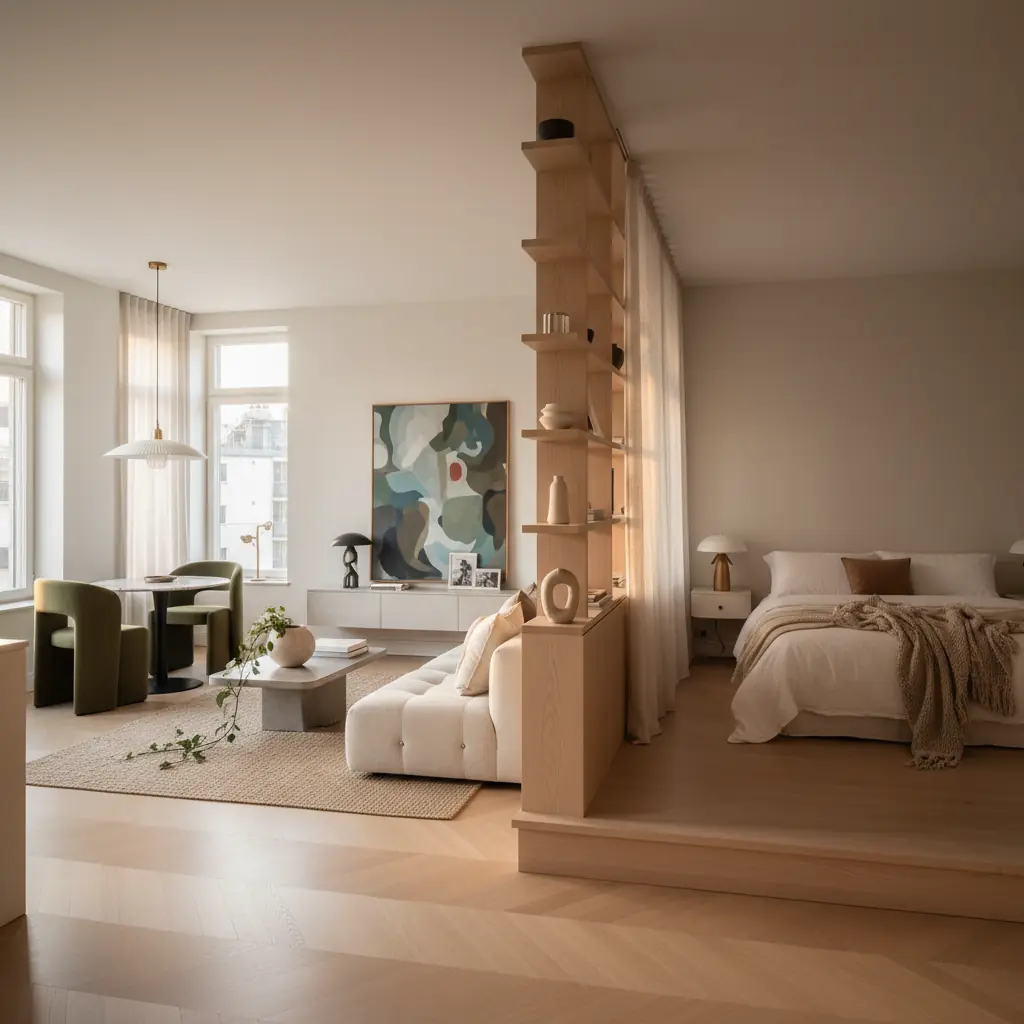
Para criar uma separação mais distinta, posicione sua cama em um canto e introduza uma divisória de ambiente. Isso transforma a área de dormir em um "quarto dentro de um quarto". As divisórias podem variar desde uma estante alta e aberta (idealmente com 180-200 cm de altura e pelo menos 75 cm de profundidade para proporcionar um bloqueio visual substancial) até uma simples cortina em um trilho montado no teto, ou até mesmo um elegante biombo dobrável.
- As **prateleiras IKEA KALLAX** (particularmente a configuração 5x5, aproximadamente 180x180 cm) são incrivelmente populares para essa estratégia. Elas funcionam efetivamente tanto como divisória visual quanto como armazenamento valioso, com compartimentos acessíveis de ambos os lados. Você pode preenchê-las com livros, objetos decorativos ou cestas de armazenamento para esconder a bagunça, melhorando ainda mais a sensação de um espaço distinto. - As **cortinas** oferecem flexibilidade incomparável. Trilhos montados no teto são a chave aqui; eles parecem mais limpos e integrados do que varões de pressão. Você pode puxar as cortinas para ter privacidade visual completa (essencial ao dormir ou receber convidados) e abri-las facilmente para restaurar a área total do studio quando desejar. Para mais ideias sobre como transformar seu espaço, o Habitas pode te ajudar a [visualizar essas mudanças na foto do seu próprio quarto](/blog/ai-furniture-arrangement-tool) antes de se comprometer com um estilo ou compra. - Os **biombos dobráveis** são portáteis e decorativos, oferecendo um toque mais leve do que prateleiras sólidas. - **Prós:** Maximiza a privacidade, especialmente em studios menores. Oferece armazenamento adicional ou espaço de exibição (com prateleiras). Opções flexíveis para luz e bloqueio visual. - **Contras:** Pode bloquear alguma luz natural dependendo do tipo de divisória. Requer colocação cuidadosa para garantir a circulação de ar adequada.
### 3. Cama Suspensa (Loft Bed): Elevando Espaço e Funcionalidade
Se o seu studio possui um pé direito generoso – pelo menos 2,7 metros (9 pés) – uma cama suspensa (loft bed) é uma solução engenhosa. Elevar a área de dormir libera todo o espaço abaixo, permitindo que você dedique essa área a uma escrivaninha, um sofá aconchegante, um pequeno guarda-roupa ou até mesmo um pequeno canto de refeições.
- **Considerações para o Pé Direito:** Embora uma cama suspensa seja tecnicamente possível com um pé direito de 2,4 metros (8 pés), muitas vezes ela se mostra desconfortável. Você geralmente teria apenas 76-91 cm (30-36 polegadas) de folga entre o colchão e o teto, o que pode parecer claustrofóbico para a maioria dos adultos. Para verdadeiro conforto e utilidade, uma folga maior é altamente recomendada. - **Prós:** Maximiza drasticamente o espaço útil, fazendo um studio pequeno parecer muito maior durante o dia. Cria um "nível" de dormir verdadeiramente distinto. - **Contras:** Requer uma escada ou degraus confortáveis e seguros. Pode ser desafiador para pessoas com problemas de mobilidade ou medo de altura. Pode parecer desconectado do resto do apartamento. A instalação pode ser complexa e cara se não for comprada como uma unidade pronta. - **Dica:** Para studios urbanos, onde o tamanho médio das novas unidades diminuiu para cerca de 46-51 metros quadrados (500-550 pés quadrados), as camas suspensas estão se tornando uma estratégia cada vez mais popular, permitindo que os moradores ganhem metragem quadrada valiosa sem uma reforma cara.
Criando Zonas com Tapetes e Iluminação: Os Heróis Anônimos
Tapetes e iluminação são, sem dúvida, as ferramentas mais simples e eficazes para definir zonas em um apartamento tipo studio. Eles trabalham em conjunto para criar divisões visuais e psicológicas sem a necessidade de quaisquer mudanças estruturais.
### Como os Tapetes Ancoram Seus Espaços
Tapetes são definidores de zona imediatos. Um tapete estrategicamente posicionado cria instantaneamente uma ilha visual que ancora os móveis que repousam sobre ele e os separa sutilmente das áreas adjacentes.
- **Área de Estar:** Um tapete de 1,5x2,1 m ou 1,8x2,7 m colocado sob o sofá e a mesa de centro comunica imediatamente "esta é a sala de estar". O tapete deve ser grande o suficiente para que pelo menos os dois pés dianteiros dos seus móveis principais (sofá, poltronas) repousem sobre ele, unificando o arranjo dos assentos. - **Canto de home office:** Um tapete menor, como um de 0,9x1,5 m ou 1,2x1,8 m, sob uma escrivaninha ou em um canto dedicado demarca claramente "este é o home office". Isso é especialmente útil se seu espaço de trabalho estiver próximo à sua área de dormir ou de estar. - **Zona de Dormir:** Na área do quarto, um tapete grande pode se estender do pé da cama, ou você pode optar por um passadeira em cada lado da cama. Isso adiciona calor e maciez, fazendo a zona de dormir parecer distinta e aconchegante. - **Além da Definição:** Tapetes também adicionam textura, cor e podem melhorar a acústica em um studio com piso rígido, tornando o espaço mais acolhedor e convidativo. Camadas de tapetes menores e texturizados sobre um tapete maior e neutro também podem adicionar profundidade e delinear ainda mais sub-zonas dentro de uma área maior.
### Iluminação: Ativando e Desativando Zonas
Um design de iluminação bem pensado é incrivelmente poderoso para reforçar as zonas. Ele permite que você "ative" áreas específicas enquanto deixa outras recuarem para a sombra, transformando a sensação do seu studio ao longo do dia e da noite.
- **Iluminação Ambiente vs. Tarefa vs. Destaque:** - **Área de Estar:** Geralmente se beneficia de um abajur de chão (luz ambiente), um abajur de mesa (iluminação de tarefa para leitura, ou iluminação de destaque para o humor) e talvez uma luz de arte para realçar um ponto focal. - **Zona do Quarto:** Deve apresentar uma iluminação mais suave e quente. Arandelas de cabeceira, pequenos abajures de mesa com tons quentes ou até mesmo luminárias pendentes dimerizáveis podem criar uma atmosfera tranquila. Usar sistemas de iluminação inteligente com controle de temperatura de cor pode permitir que você mude de uma luz fria e energizante para uma luz quente e relaxante com um toque. - **Zona da Escrivaninha/Trabalho:** Um abajur de tarefa dedicado é essencial para o trabalho focado, prevenindo a fadiga ocular. Posicione-o para iluminar diretamente sua área de trabalho. - **O Poder dos Dimmers:** Instalar dimmers em todas as suas fontes de luz proporciona um controle incomparável sobre o ambiente. Quando você acende apenas as luzes da sala de estar e diminui as da zona do quarto, por exemplo, o studio se transforma psicologicamente em uma sala de estar – a área escura da cama desaparece graciosamente da consciência. - **Evite Iluminação de Teto Uniforme:** Um erro comum é depender apenas de uma única luminária de teto. Isso banha todo o studio em luz uniforme, achatando todas as suas zonas cuidadosamente definidas e fazendo o ambiente parecer uma caixa indiferenciada. Em vez disso, use múltiplas fontes de luz em diferentes alturas e posições para criar bolsões de luz e sombra que definem espaços de forma tão eficaz quanto paredes físicas.
Móveis como Divisórias de Ambiente: Soluções Inteligentes e Multifuncionais
Seus móveis existentes são frequentemente suas divisórias de ambiente mais eficazes e econômicas. O truque é repensar seu posicionamento e aproveitar sua estrutura inerente para criar separação visual.
### A Versatilidade do Sofá
Seu sofá é talvez a melhor divisória de ambiente que você possui – no entanto, muitas pessoas o posicionam incorretamente em um studio. Em vez de empurrá-lo contra uma parede, flutue-o no meio do studio. Oriente suas costas para a área da cama e sua frente para sua zona de estar designada (talvez de frente para uma TV, uma estante ou uma janela). As costas do sofá atuam como uma barreira visual natural entre as áreas de dormir e de estar, sem bloquear a preciosa luz natural ou o fluxo de ar.
- **Aprimorando a Divisão:** Uma mesa console colocada atrás do sofá (contra suas costas) reforça ainda mais essa separação. Também oferece uma superfície prática para luminárias, objetos decorativos ou até mesmo uma estação de carregamento, adicionando função e estilo a ambas as zonas. Sofás modulares com chaises ou configurações em L também podem ser excelentes para criar uma área de lounge distinta.
### Estantes Abertas: Separação com Luz
Estantes abertas são divisórias ideais porque proporcionam separação visual, permitindo a passagem da luz. Uma estante com 60-80% de preenchimento (deixando algumas lacunas abertas) permite que a luz natural filtre de uma zona para outra, evitando que qualquer área se sinta completamente isolada ou escura.
- **Posicionamento Estratégico:** Divisórias sólidas, como guarda-roupas ou cômodas altas, bloqueiam mais luz, mas oferecem armazenamento significativo. Use-as onde o bloqueio de luz é aceitável – por exemplo, entre a zona de dormir e uma parede sem janelas, ou para criar um pseudo-closet. Reserve divisórias abertas para áreas onde o fluxo de luz é crucial, como entre a cama e uma janela. - **Além dos Livros:** Essas prateleiras podem abrigar plantas, obras de arte e itens decorativos que contribuem para a estética de ambas as zonas adjacentes. Esta é uma maneira econômica de obter um visual personalizado; um bom sistema de estantes modulares de qualidade pode começar a partir de R$ 1.000, uma fração do custo de uma parede construída.
### Trilhos de Cortina: A Divisória Flexível Definitiva
Os trilhos de cortina montados no teto oferecem a solução de divisão mais flexível e adaptável. Ao contrário dos varões de tensão, os trilhos de teto proporcionam um visual limpo e integrado e podem até seguir caminhos curvos ou em forma de L, oferecendo opções de divisão altamente versáteis.
- **Escolha de Materiais:** Use cortinas transparentes para uma separação sutil que maximiza a luz, ou opte por tecidos mais pesados e opacos para privacidade visual completa e até mesmo alguma privacidade acústica. Cortinas blackout são excelentes para a zona de dormir. - **Vantagem Habitas:** Visualizar essas divisórias flexíveis pode ser complicado. Ferramentas como o Habitas permitem que você carregue a foto do seu studio e teste várias posições de divisória – desde arranjos de estantes até trilhos de cortina e orientações específicas de móveis – ajudando você a encontrar o layout perfeito antes de começar a mover móveis pesados ou investir em novas peças. Esse processo iterativo, que leva segundos com IA, tradicionalmente levava dias ou semanas com maquetes físicas ou softwares caros de renderização 3D.
A Zona de Home Office: Essencial para a Produtividade
Na era do trabalho remoto, uma zona de trabalho dedicada é um recurso inegociável para muitos moradores de studio. Mesmo em um único ambiente, criar essa separação é vital para a produtividade e o bem-estar mental.
### Pegada Mínima e Posicionamento Inteligente
A pegada funcional mínima para uma configuração de escrivaninha confortável geralmente requer cerca de 60x120 cm para a escrivaninha em si, mais pelo menos 90 cm de folga atrás da cadeira para um movimento confortável. Isso totaliza aproximadamente 2,2 metros quadrados. Essa zona compacta pode se encaixar eficientemente contra uma parede, bem acomodada em um canto, ou até mesmo posicionada perpendicularmente a uma janela.
O posicionamento mais eficaz da escrivaninha em um studio é frequentemente de frente para uma parede ou uma janela – nunca de frente para a cama ou para a área de estar principal. Quando suas costas estão voltadas para o resto do studio enquanto você trabalha, você está psicologicamente "no home office". Quando você se vira, você está "em casa". Essa separação mental, por mais sutil que possa parecer, é surpreendentemente poderosa para reduzir a sensação de que você vive constantemente em seu local de trabalho e pode aumentar a produtividade em até 20%.
### Maximizando o Espaço com Escrivaninhas Dobráveis
Se o espaço é um luxo absoluto, uma escrivaninha dobrável montada na parede (muitas vezes chamada de escrivaninha Murphy) é uma solução engenhosa. Ela oferece uma superfície de trabalho completa e ergonômica quando necessária e se dobra rente à parede quando não está em uso. Uma escrivaninha dobrável típica de 76x60 cm ocupa apenas cerca de 0,5 metros quadrados de espaço na parede e zero espaço no chão quando dobrada. Combine-a com um banquinho leve e dobrável que se encaixa por baixo ou pendura em um gancho na parede, e seu home office inteiro pode desaparecer no final do dia de trabalho, recuperando seu studio para o lazer.
### Ergonomia e Integração Tecnológica
Não negligencie a ergonomia, mesmo em um espaço pequeno. Invista em uma cadeira confortável e de apoio se você passa horas na sua escrivaninha. Considere um braço para monitor para elevar sua tela e liberar espaço na escrivaninha. O gerenciamento de cabos também é crucial; use clipes para cabos, abraçadeiras e organizadores discretos para manter seu espaço de trabalho limpo e profissional. Um espaço de trabalho limpo e organizado contribui diretamente para uma mente clara e focada.
Soluções de Armazenamento: Cada Centímetro Conta
Em um apartamento tipo studio, o armazenamento não se trata apenas de organização; trata-se de maximizar cada centímetro vertical e horizontal. Cada peça de mobiliário deve conter armazenamento ou ativamente possibilitá-lo.
### Móveis Multifuncionais: O Melhor Amigo do Apartamento Studio
- **Armazenamento Embaixo da Cama:** Camas com gavetas embutidas por baixo ou aquelas projetadas com elevadores hidráulicos para acessar o armazenamento sob o colchão podem recuperar significativos 0,4 a 0,6 metros cúbicos de armazenamento. Esse espaço, de outra forma, seria espaço morto, acumulando poeira. Eles são perfeitos para roupas de cama, roupas sazonais ou itens usados com menos frequência. - **Pufes com Armazenamento:** Essas peças versáteis servem a múltiplos propósitos: assento extra, um apoio confortável para os pés, uma prática mesa de centro (especialmente com uma bandeja em cima) e armazenamento oculto para cobertores, livros ou controles remotos. - **Mesas de Centro com Armazenamento:** Procure mesas de centro com gavetas, tampos elevatórios ou prateleiras abertas para guardar revistas, porta-copos ou pequenos eletrônicos.
### Armazenamento Vertical: Liberando Potencial Oculto
- **Prateleiras de Parede:** Utilize o espaço vertical muitas vezes esquecido acima de portas, janelas e até mesmo da televisão. Prateleiras flutuantes ou sistemas de prateleiras modulares podem acomodar livros, decoração ou até mesmo o excesso de utensílios de cozinha sem ocupar um precioso espaço no chão. - **Unidades Altas e Estreitas:** Unidades de torre finas ou armários de despensa podem se encaixar em nichos estranhos e fornecer armazenamento vertical substancial para tudo, desde produtos de limpeza a itens de despensa. - **Painéis Perfurados (Pegboards) e Organizadores de Parede:** Em uma cozinha ou zona de trabalho, um painel perfurado montado na parede pode manter ferramentas e utensílios essenciais organizados e acessíveis, liberando espaço em gavetas e bancadas. - **Armários até o Teto:** Se você estiver realizando uma reforma mais significativa (ou tiver tetos muito altos), armários embutidos personalizados que se estendem até o teto proporcionam capacidade máxima de armazenamento e um visual integrado e sem costuras. Isso pode ser um investimento que vale a pena; estudos mostram que um bom armazenamento e organização são as principais prioridades para 60% dos locatários e compradores de imóveis em espaços menores.
Usando Cor, Textura e Obras de Arte para Definir Zonas
Além das divisórias físicas, escolhas estéticas sutis podem influenciar profundamente como um studio é zoneado. Cor, textura e obras de arte são ferramentas psicológicas poderosas que reforçam sua estratégia de layout.
### Paletas de Cores para Zonas Definidas
- **Paredes de Destaque:** Uma parede de destaque pintada em sua zona de dormir, talvez em um tom mais escuro e calmo, instantaneamente a diferencia da área de estar mais clara e ativa. Isso cria um "abraço" visual ao redor da cama, fazendo com que ela se sinta mais fechada e íntima. - **Coeso vs. Contrastante:** Você pode manter uma paleta de cores geralmente coesa e mais clara em todo o studio para garantir o fluxo, e então introduzir toques de cor em cada zona através de estofados (almofadas, mantas, tapetes) que delineiam sutilmente as áreas. Alternativamente, você pode usar tons de tinta ligeiramente contrastantes, mas complementares, em paredes adjacentes para denotar diferentes funções sem uma divisão nítida. [Usar um gerador de paleta de cores com IA](/blog/ai-color-palette-generator) pode ajudá-lo a explorar combinações harmoniosas adaptadas ao seu espaço.
### Jogo de Texturas para Distinção Sensorial
- **Tapetes e Tecidos:** Como mencionado, os tapetes são excelentes. Além de seu papel visual, sua textura contribui para a experiência sensorial. Um tapete felpudo na área de estar tem uma sensação diferente de um tapete de trama plana no canto de jantar ou um tapete de algodão macio ao lado da cama. - **Materiais dos Móveis:** Misture e combine materiais para definir zonas. Um sofá elegante e moderno na sala de estar, uma escrivaninha de madeira rústica no canto do home office e peças estofadas macias no quarto podem sinalizar uma função diferente. - **Revestimentos de Parede:** Considere um papel de parede texturizado ou até mesmo painéis de madeira em uma parede dentro de uma zona específica (por exemplo, atrás da cama) para adicionar profundidade e um caráter distinto.
### Obras de Arte como Âncoras e Pontos Focais
- **Paredes de Galeria:** Uma parede de galeria curada na área de estar a designa imediatamente como um espaço social e decorativo. - **Arte em Grande Escala:** Uma única e grande obra de arte acima do sofá ou da cama pode servir como um poderoso ponto focal, atraindo o olhar e ancorando aquela zona específica. - **Espelhos:** Espelhos estrategicamente posicionados podem não apenas refletir a luz e fazer um espaço pequeno parecer maior, mas também expandir visualmente uma zona. Por exemplo, um grande espelho atrás de uma mesa de jantar pode fazer com que essa área pareça mais espaçosa e grandiosa.
Exemplos Reais de Layout de Studio: Tornando-o Tangível
Vamos ver como essas estratégias se unem em layouts de studio reais de tamanhos variados.
### Um Studio de 37 Metros Quadrados: Equilibrando Quatro Zonas
Considere um studio retangular típico de 37 metros quadrados (400 pés quadrados).
1. **Zona de Entrada/Cozinha:** Você pode entrar diretamente em uma área de cozinha compacta, geralmente alinhada em uma parede (2,4-3 metros de bancada e armários). Uma pequena mesa de jantar com abas dobráveis pode ser integrada aqui, dobrando-se quando não estiver em uso. 2. **Zona de Estar:** Passando a cozinha, um tapete de 1,5x2,1 m ou 1,8x2,7 m define a área de estar. Um sofá de três lugares flutua perpendicularmente à parede, suas costas criando a principal divisória visual. Uma TV elegante montada na parede ou um console de mídia baixo fica de frente para o sofá. 3. **Zona de Dormir:** Atrás do sofá, a cama fica contra a parede do fundo com mesas de cabeceira compactas ou prateleiras flutuantes em cada lado. Um trilho de cortina montado no teto pode ser instalado logo atrás do sofá, oferecendo privacidade total quando fechado. 4. **Zona de Trabalho:** Uma escrivaninha dedicada ocupa um canto perto da janela, posicionada perpendicularmente ao vidro. Isso proporciona luz natural e uma vista inspiradora enquanto trabalha, mantendo as costas do trabalhador para o resto do apartamento. 5. **Armazenamento:** Um guarda-roupa ou sistema de armários reveste a parede perto da entrada, utilizando o espaço vertical. Armazenamento embaixo da cama e uma mesa console atrás do sofá fornecem pontos adicionais.
Este layout alcança quatro zonas distintas (cozinha/jantar, estar, dormir, trabalhar) dentro de um único ambiente, cada uma com limites claros estabelecidos através do posicionamento dos móveis, tapetes e fontes de luz variadas.
### Um Studio de 28 Metros Quadrados: Priorização Implacável
Para um studio verdadeiramente compacto de 28 metros quadrados (300 pés quadrados), a priorização deve ser implacável.
1. **Cama e Trabalho Compartilham uma Zona:** A cama é colocada contra a parede mais longa. Em vez de uma escrivaninha separada, uma escrivaninha flutuante compacta montada na parede (60x90 cm) é instalada aos pés da cama, talvez de frente para uma janela ou uma parede de galeria cuidadosamente curada para interesse visual. Um pequeno banquinho ergonômico se encaixa perfeitamente por baixo. 2. **Zona de Estar Compacta:** O sofá pode ser substituído por duas poltronas confortáveis de pequena escala ou um loveseat que ocupam menos espaço visual e físico, mas ainda definem uma zona de "estar". Uma pequena mesa de centro redonda com armazenamento ancoraria essa área. 3. **Cozinha/Jantar:** A cozinha permanece em um layout de parede única, potencialmente com uma extensão de balcão retrátil para refeições ou preparo. 4. **Toda Superfície Tem Dupla Função:** Pufes com armazenamento, uma mesa console estreita na entrada para chaves e prateleiras montadas na parede tornam-se essenciais. Todas as roupas provavelmente estariam em um guarda-roupa alto e estreito ou em um sistema de closet bem organizado.
Esses layouts compactos se beneficiam enormemente das ferramentas de visualização de IA. O Habitas permite que você teste vários arranjos sem mover fisicamente um único móvel. Em um espaço de 28 metros quadrados, isso significa que você pode iterar dezenas de ideias em minutos, em vez de passar um dia inteiro reorganizando, apenas para descobrir que o layout não funciona. Essa eficiência economiza tempo, energia e potencial frustração, garantindo que você crie um espaço que parece feito sob medida para o seu estilo de vida.
Perguntas Frequentes
### Como faço para meu apartamento tipo studio parecer maior do que é?
Para fazer seu apartamento tipo studio parecer maior, concentre-se em truques visuais e organização inteligente. Use paletas de cores claras e neutras, especialmente nas paredes, para criar um pano de fundo expansivo. Incorpore espelhos estrategicamente para refletir a luz e as vistas, duplicando efetivamente o espaço percebido. Opte por móveis multifuncionais (como pufes com armazenamento ou um sofá-cama) e peças com perfis finos ou pernas expostas para manter uma sensação arejada. Maximize o armazenamento vertical para manter a bagunça fora do chão e use um piso consistente em todo o ambiente para evitar quebras visuais que fragmentam o espaço. Uma iluminação bem pensada, com múltiplas fontes e dimmers, também pode criar profundidade.
### Quais são os melhores móveis para um apartamento tipo studio?
Os melhores móveis para um apartamento tipo studio são multifuncionais, dimensionados adequadamente e oferecem armazenamento inteligente. Peças-chave incluem: um sofá-cama ou um sofá que "flutua" para definir zonas, um pufe com armazenamento ou mesa de centro com armazenamento embutido, uma escrivaninha montada na parede ou dobrável para uma zona de trabalho discreta, e estantes abertas ou unidades de prateleiras modulares que podem servir tanto como armazenamento quanto como divisórias de ambiente. Camas com gavetas embaixo ou armazenamento elevável também são inestimáveis. Priorize itens que possam servir a pelo menos dois propósitos para maximizar a eficiência.
### Como posso ter privacidade em um apartamento tipo studio?
Conseguir privacidade em um apartamento tipo studio envolve estratégias visuais e acústicas. O método mais eficaz é usar divisórias físicas como cortinas montadas no teto (tecido pesado para privacidade visual e alguma acústica), estantes altas e abertas (como a IKEA KALLAX), ou biombos elegantes. O "flutuar" estratégico de móveis, como colocar as costas de um sofá viradas para sua cama, também cria uma barreira psicológica. Para privacidade sonora, considere adicionar tapetes, móveis estofados e obras de arte que absorvam o som. Para controle de luz e privacidade visual externa, invista em persianas ou cortinas blackout.
### É difícil morar em um apartamento tipo studio?
Morar em um apartamento tipo studio pode ser desafiador para alguns devido ao espaço limitado e à necessidade constante de organização e design intencional. No entanto, também é muito gratificante para outros, oferecendo vantagens como aluguel mais baixo, contas de serviços públicos reduzidas e um estilo de vida simplificado. A chave para uma vida bem-sucedida em studio reside no zoneamento eficaz, na organização implacável e na adoção de soluções multifuncionais. Com um layout bem pensado e escolhas de design inteligentes, um studio pode parecer surpreendentemente espaçoso e incrivelmente aconchegante, tornando-o um lar confortável e eficiente.
### Quanto custa mobiliar um apartamento tipo studio com estilo?
O custo para mobiliar um apartamento tipo studio com estilo pode variar amplamente, desde opções econômicas até designs de alta qualidade. Para uma configuração funcional e esteticamente agradável, você pode esperar gastar entre **R$ 10.000 a R$ 35.000** em móveis essenciais novos (cama, sofá, escrivaninha, armazenamento). Este orçamento permite uma mistura de achados da IKEA, Target ou Wayfair com algumas peças um pouco mais substanciais. Se você incorporar soluções personalizadas, peças de design ou materiais de maior qualidade, os custos podem facilmente exceder **R$ 50.000 a R$ 75.000**. Comprar em brechós, projetos DIY e usar ferramentas de design de IA como o Habitas para visualizar e planejar podem ajudar você a obter um visual estiloso com um orçamento mais modesto.