Dominio de la Distribución de Muebles: Reglas de Diseñador, Diseños Inteligentes y Herramientas de IA
Descubre los secretos de los diseñadores de interiores profesionales para una distribución de muebles perfecta. Aprende reglas esenciales para el flujo de tráfico, zonas de conversación y la técnica de "flotación" para hacer que cualquier habitación se sienta más grande y funcional.
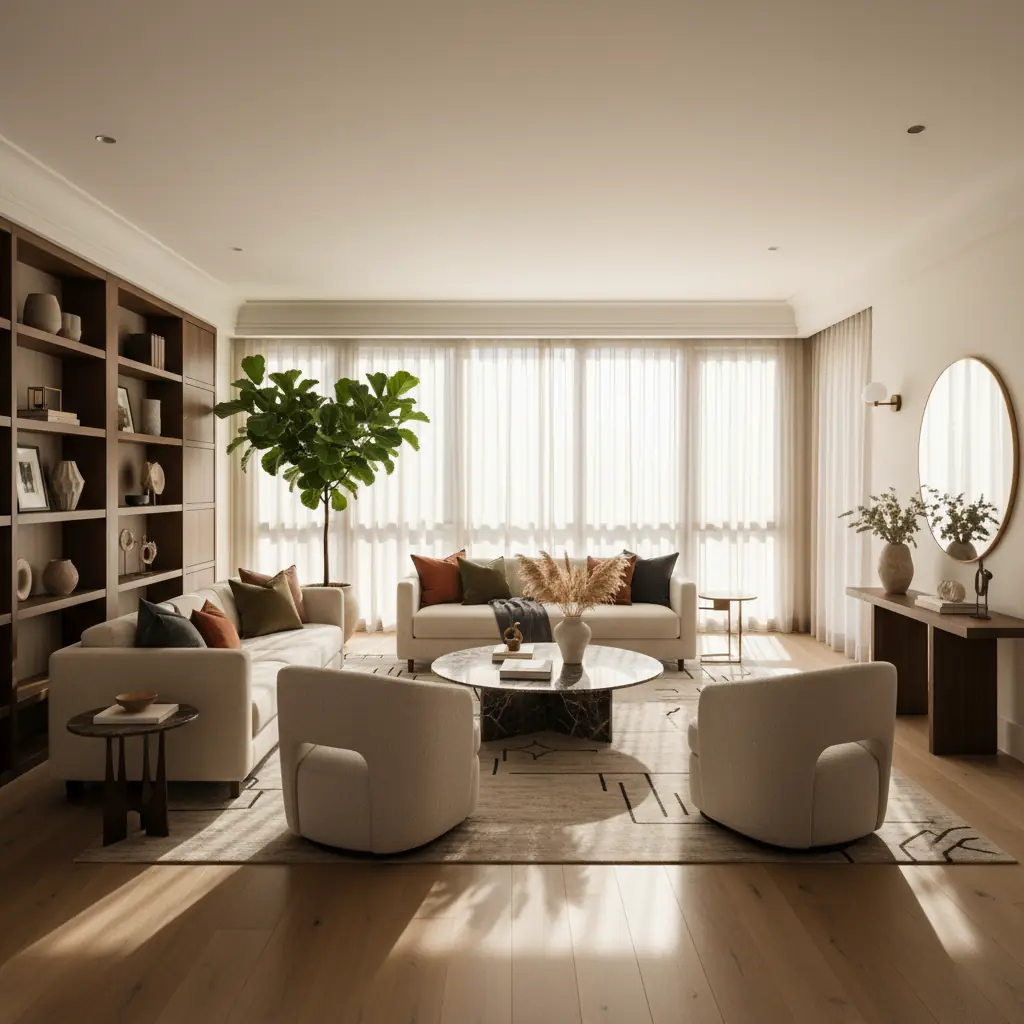
Las Reglas Fundamentales que Todo Diseñador Sigue para una Circulación Impecable
¿Alguna vez te has preguntado por qué algunas habitaciones simplemente se sienten "bien" mientras que otras resultan incómodas o estrechas, incluso si tienen el mismo tamaño? El secreto reside en un conjunto de reglas espaciales fundamentales que los diseñadores de interiores profesionales aplican rigurosamente. Estas no son solo sugerencias; son la base de espacios cómodos, funcionales y estéticamente agradables.
### ¿Qué es la Regla de los 90 Centímetros para la Circulación?
La primera y más crítica regla es la circulación: cada pasillo principal en una habitación necesita al menos 90 cm (36 pulgadas) de espacio libre y sin obstáculos. Este no es un número arbitrario; es el ancho mínimo requerido para que una persona camine cómodamente sin tener que ponerse de lado o rozar los muebles. Imagina intentar moverte por un camino más estrecho llevando una bandeja de bebidas o con invitados paseando; esto hace que la habitación se sienta congestionada al instante, independientemente de su metraje cuadrado real. En áreas de alto tránsito, como el camino principal desde una entrada a una sala de estar, espacios aún más amplios (hasta 120 cm) pueden mejorar la sensación de amplitud y lujo. Estudios demuestran que las habitaciones con una circulación adecuada pueden sentirse hasta un 20% más grandes y acogedoras, impactando significativamente el valor percibido de un hogar.
### Cómo Crear Zonas de Conversación Atractivas
La segunda regla rige las áreas de conversación. Los asientos deben distribuirse de modo que las personas no estén a más de 2.4 a 3 metros (8 a 10 pies) de distancia entre sí. Más allá de esta distancia, la conversación se vuelve forzada, las voces tienden a subir y se pierde la intimidad de la interacción. Las personas se inclinan hacia adelante o estiran el cuello de forma subconsciente, lo que provoca incomodidad.
Si tu sala de estar o espacio de planta abierta es más grande que este rango de conversación ideal, la solución no es gritar a través de la habitación. En su lugar, crea múltiples zonas de conversación más pequeñas. Por ejemplo, una sala grande podría tener un grupo de asientos principal alrededor de una chimenea, y un grupo secundario con dos sillones y una pequeña mesa auxiliar cerca de una ventana, perfecto para charlas más íntimas o lectura. Esta segmentación estratégica hace que una habitación grande se sienta a la vez amplia y acogedora, adaptándose a diferentes dinámicas sociales.
### ¿Por qué el Anclaje de Alfombras es Crucial para la Cohesión?
La tercera regla, a menudo pasada por alto por los propietarios, es el anclaje: cada grupo de asientos necesita una alfombra lo suficientemente grande como para que al menos las patas delanteras de todas las piezas principales (sofá, sillas, bancos auxiliares) descansen sobre ella. Una alfombra que "flota" como una estampilla en medio de una distribución de muebles hace que toda la habitación parezca inconexa, inacabada y más pequeña de lo que es.
Una alfombra del tamaño correcto "aterriza" visualmente los muebles, uniendo las piezas individuales en una unidad cohesiva. Define el área de conversación, proporcionando una superficie suave para los pies y añadiendo textura y color al espacio. Para una sensación aún más lujosa, busca una alfombra lo suficientemente grande como para que las cuatro patas de tu sofá y sillas se asienten completamente sobre ella, dejando solo unos pocos centímetros de suelo visible alrededor del perímetro.
Tres Diseños de Sala Comprobados para Cada Espacio
Elegir el diseño correcto es fundamental para un buen diseño. Estas tres distribuciones son soluciones recurrentes para los diseñadores, adaptables a diversas formas y tamaños de habitaciones.
### La Versatilidad del Diseño Simétrico
El diseño simétrico es la disposición más segura y universalmente agradable. Típicamente, coloca un sofá frente a dos sillas a juego, con una mesa de centro u otomana centrada entre ellas. A menudo, mesas auxiliares y lámparas idénticas flanquean el sofá. Esta distribución crea una sensación de equilibrio, formalidad y calma. Es increíblemente versátil, funcionando maravillosamente en habitaciones de casi cualquier tamaño y acomodando diversos estilos de diseño, desde el tradicional hasta el contemporáneo. Para habitaciones más grandes, dos sofás pueden enfrentarse, flanqueados por dos sillas, manteniendo la simetría y maximizando los asientos.
### Maximizando Asientos con el Diseño en Forma de L
El diseño en forma de L utiliza un sofá seccional o una combinación de un sofá y una chaise longue (o un sillón adicional) colocados a lo largo de dos paredes adyacentes. Esta configuración crea un rincón natural y acogedor que maximiza la capacidad de asientos y es particularmente efectivo en espacios de planta abierta. Actúa como un límite suave, definiendo la sala de estar sin necesidad de paredes físicas, lo que lo hace ideal para crear zonas distintas dentro de un espacio más grande e indefinido. Una forma de L fomenta la interacción relajada y es perfecta para reuniones familiares o noches de cine.
### El Genio Contraintuitivo del Diseño Flotante
El diseño flotante es un enfoque sofisticado y contraintuitivo que aleja todos los muebles de las paredes y los agrupa en el centro de la habitación. Aunque podría parecer que esto reduciría el espacio, en realidad hace que las habitaciones se sientan significativamente más grandes. El espacio de suelo visible alrededor del perímetro crea una ilusión de apertura y ligereza, evitando el efecto de "pista de bolos" de los muebles alineados contra las paredes. Una distribución flotante con un sofá, dos sillas y una mesa de centro funciona maravillosamente en habitaciones de 4.2 metros (14 pies) de ancho o más grandes, permitiendo un amplio espacio de circulación alrededor del grupo. El diseño flotante puede expandir visualmente el tamaño percibido de una habitación hasta en un 15%. Esta técnica crea un área de conversación más íntima al mismo tiempo que hace que el espacio general se sienta más expansivo.
### Combinando Diseños con Formas de Habitación
No dejes que el tamaño de la habitación sea tu única guía; la forma de la habitación suele ser más crítica.
- **Habitaciones Largas y Estrechas:** Estas se benefician enormemente de un diseño en forma de L o dividiendo la habitación en múltiples zonas. Colocar los muebles perpendicularmente a las paredes largas puede romper el efecto de túnel. - **Habitaciones Cuadradas:** Funcionan mejor con distribuciones simétricas o flotantes, enfatizando el eje central y creando equilibrio. - **Habitaciones de Forma Irregular, Alcobas o Ángulos:** A menudo requieren un enfoque combinado. Utiliza la pared más grande y sencilla para tu disposición de asientos principal y deja que una alcoba o un rincón inusual se convierta en un rincón de lectura designado, un pequeño espacio de trabajo o un área de exposición para arte o plantas. Pensar creativamente sobre estos espacios "incómodos" puede transformarlos en características encantadoras. Para más consejos sobre espacios desafiantes, consulta nuestra guía sobre [soluciones para habitaciones con formas incómodas](/blog/awkward-room-shape-solutions).
Detalles para la Distribución de Dormitorios, Comedores y Recibidores
Más allá de la sala de estar, se aplican reglas específicas a otras áreas clave de tu hogar para garantizar tanto la funcionalidad como la comodidad.
### Cómo Distribuir un Dormitorio para un Confort Óptimo
En los dormitorios, la cama casi siempre debe estar centrada en la pared más grande, proporcionando un punto focal y una sensación de calma. Es crucial dejar el mismo espacio en ambos lados para las mesas de noche. Necesitas un mínimo de 60 cm (24 pulgadas) a cada lado para un acceso cómodo, suficiente para pasar sin chocar con los muebles y para acomodar una mesa de noche estándar con una lámpara. Si tu habitación no puede acomodar cómodamente 60 cm en ambos lados, es mejor empujar la cama contra una pared y aceptar la asimetría en lugar de crear dos pasillos inutilizables y estrechos. Considera añadir un banco o un otomán de almacenamiento al pie de la cama si el espacio lo permite. Esto proporciona un lugar conveniente para vestirse y añade otra capa de diseño. Un dormitorio bien distribuido puede mejorar la calidad del sueño al reducir el desorden visual y promover la relajación, con un 68% de las personas reportando un mejor descanso en espacios organizados.
### Dimensiones y Circulación del Comedor
Los comedores requieren al menos 90 cm (36 pulgadas) entre el borde de la mesa y la pared o mueble más cercano (como un aparador o una vitrina). Este espacio libre crítico permite que las sillas se retiren fácilmente y que las personas pasen cómodamente detrás de los comensales sentados. Un error común es comprar una mesa de comedor que llena visualmente la habitación; si bien la mesa en sí puede parecer proporcional, una vez que se añaden las sillas y la gente se sienta, la habitación se convierte en una pesadilla de tráfico. Para calcular el ancho máximo ideal de tu mesa, mide el ancho de tu habitación, resta 180 cm (90 cm a cada lado), y ese es tu máximo seguro. Por ejemplo, una habitación de 3.65 metros (144 pulgadas) de ancho puede acomodar cómodamente una mesa de hasta 1.80 metros (72 pulgadas) de ancho.
### Diseñando un Recibidor Acogedor
El recibidor marca el tono de todo tu hogar. Incluso los recibidores pequeños se benefician de una distribución bien pensada. Una mesa consola estrecha (de 30 a 45 cm de profundidad) suele ser ideal, proporcionando una superficie para llaves, correo y uno o dos objetos decorativos. Encima, un espejo o una pieza de arte puede crear un punto focal. Asegura al menos 90 cm de pasillo despejado desde la puerta principal hasta las áreas de estar principales. Si el espacio lo permite, un pequeño banco u otomán ofrece un lugar conveniente para sentarse y quitarse los zapatos. El almacenamiento práctico, como ganchos para abrigos o un zapatero delgado, ayuda a mantener una primera impresión ordenada y acogedora.
La Técnica de Flotación: Por Qué las Paredes No Son Tus Amigas
El cambio más impactante que la mayoría de las personas puede hacer para elevar el diseño de su hogar es alejar los muebles de las paredes. Es un impulso instintivo empujar todo contra el perímetro —parece que maximiza el espacio— pero en realidad crea un efecto de "pista de bolos" estéril y a menudo incómodo con una zona muerta en el centro de la habitación.
Intenta mover tu sofá hacia adelante solo de 15 a 30 cm (6 a 12 pulgadas). El sutil espacio crea un "respiro" y permite un espacio negativo visualmente interesante. Incluso puedes colocar una mesa consola estrecha detrás de un sofá flotante, añadiendo una lámpara para luz ambiental, un expositor de arte o un lugar para plantas. Angula tus sillas auxiliares ligeramente hacia el área de conversación en lugar de colocarlas directamente contra la pared. Estos pequeños movimientos deliberados crean intimidad, mejoran significativamente el flujo de la conversación y hacen que la habitación se sienta diseñada intencionalmente en lugar de arreglada a la ligera. La profundidad visual añadida y las zonas definidas evitan la sensación de "sala de espera" e introducen una sensación de flujo dinámico.
Dominando la Escala, Proporción y Evitando Errores Comunes
Más allá de las piezas individuales, la armonía general de una habitación depende de la escala y la proporción. Ignorar estos principios conduce a una habitación que se siente perpetuamente "desequilibrada".
### ¿Cuál es el Error Más Común en la Distribución de Muebles?
El error más común en la distribución de muebles es la desproporción de escala. Imagina un delicado "loveseat" (sofá pequeño) "tragado" por una vasta sala de estar; parece mobiliario de casa de muñecas. Por el contrario, un sofá seccional de gran tamaño apretujado en una habitación pequeña hace que todo se sienta claustrofóbico y desequilibrado. Una buena regla general es que tu pieza de asiento principal (por ejemplo, el sofá) debe tener aproximadamente entre dos tercios y tres cuartos de la longitud de la pared a la que se enfrenta, dejando espacio "para respirar" a cada lado. Además, considera la altura de tus muebles en relación con la altura del techo. Piezas altas en una habitación con techos bajos pueden sentirse opresivas, mientras que los muebles bajos en una habitación majestuosa podrían sentirse perdidos.
### Logrando la Distribución del Peso Visual
Igualmente importante es la distribución del peso visual. Si tienes un mueble pesado, oscuro o sustancial en un lado de la habitación y nada visualmente equivalente en el otro, la habitación se sentirá desequilibrada y asimétrica. El equilibrio no significa necesariamente simetría; significa distribuir el "peso" visual de manera uniforme. Por ejemplo, una estantería alta y abierta en un lado puede equilibrar visualmente un sofá robusto y macizo al otro lado de la habitación. Un par de sillones delgados con respaldos abiertos pueden equilibrar un sillón individual y pesado. Entrena tu ojo para _sentir_ el peso visual de los objetos, no solo para medir sus dimensiones físicas. Considera el color, la masa, la textura y la altura al evaluar el peso visual. Los colores más oscuros, las formas sólidas y los elementos más grandes generalmente tienen más peso visual.
### El Arte de la Estratificación y la Iluminación
Una vez distribuidos los muebles principales, la estratificación con textiles, accesorios e iluminación bien pensada transforma un espacio funcional en un santuario personal.
- **Textiles:** Introduce mantas, cojines decorativos y cortinas para añadir calidez, color y textura. Estos elementos suaves suavizan las líneas duras y mejoran el confort. - **Accesorios:** El arte, las esculturas, las plantas y los objetos decorativos dan vida a una habitación. Dispónlos en números impares (grupos de tres o cinco suelen verse mejor) y varía sus alturas y texturas. Piensa en crear "viñetas" en mesas de centro, mesas auxiliares o estanterías. Para inspirarte, explora diferentes estilos de diseño como [ideas para dormitorios bohemios](/blog/bohemian-bedroom-ideas) o [ideas para salas de estar costeras](/blog/coastal-living-room-ideas). - **Iluminación:** La iluminación por capas es fundamental. No te bases únicamente en las luces de techo. Combina iluminación ambiental (iluminación general), iluminación de trabajo (para leer o trabajar) e iluminación de acento (para resaltar arte o características arquitectónicas). Lámparas de mesa, lámparas de pie y apliques a diferentes alturas añaden profundidad, crean ambiente y pueden hacer que una habitación se sienta más grande y acogedora.
Herramientas Gratuitas y con IA para Planificar Tu Distribución
Antes de embarcarte en la ardua tarea de mover físicamente muebles pesados, planifica tu distribución en papel o en pantalla. Este paso crucial ahorra horas de dolor de espalda e indecisión.
### Planificación Tradicional con Papel Cuadriculado
El papel cuadriculado sigue siendo una de las mejores y más sencillas herramientas. Utiliza una escala de un cuarto de pulgada por pie (1:48), dibuja el contorno de tu habitación con medidas precisas, marcando ventanas, puertas y cualquier elemento empotrado. Luego, recorta formas a escala que representen tus muebles y deslízalos. Este método táctil toma unos 20 minutos y puede ahorrar horas de reordenamiento físico y posibles daños a tus pisos o muebles.
### Herramientas de Planificación Digital para Todos los Presupuestos
Varias opciones digitales ofrecen capacidades de planificación más sofisticadas, muchas con versiones básicas gratuitas:
- **RoomSketcher:** Fácil de usar para crear planos de planta y visualizaciones 3D. - **Floorplanner:** Excelente para dibujar distribuciones y experimentar con muebles. - **IKEA Room Planner:** Perfecto si trabajas con muebles IKEA, permitiéndote arrastrar y soltar piezas en tu habitación. - **Pottery Barn & Crate & Barrel Room Planners:** Muchos minoristas de muebles ofrecen sus propias herramientas gratuitas para visualizar sus productos específicos en un entorno de habitación.
### El Poder de la IA en la Distribución de Muebles
Para un enfoque verdaderamente avanzado y visualmente atractivo, herramientas como Habitas revolucionan el proceso de planificación. En lugar de planos de planta genéricos, puedes subir una foto de tu habitación real y visualizar cómo se verían diferentes distribuciones de muebles, estilos e incluso paletas de colores en tu espacio utilizando renders generados por IA. Ver una vista previa fotorrealista de tu habitación con los muebles redistribuidos, nueva decoración o incluso un color de pared diferente es mucho más convincente e informativo que un plano de planta superior o una simple representación en 3D. Las herramientas de visualización de IA como Habitas pueden reducir el tiempo de planificación del diseño en más de un 90%, ofreciendo renders fotorrealistas en minutos en lugar de semanas. Esto te permite experimentar con innumerables posibilidades, desde una estética de [guía de diseño biofílico](/blog/biophilic-design-guide) hasta [looks minimalistas modernos](/blog/all-white-room-design-tips), antes de hacer cualquier compromiso costoso. Aprende más sobre cómo la IA puede transformar tu proceso de diseño con nuestra [herramienta de distribución de muebles con IA](/blog/ai-furniture-arrangement-tool).
Preguntas Frecuentes
### ¿Cuáles son los errores más comunes en la distribución de muebles?
Los errores más comunes incluyen empujar todos los muebles contra las paredes (creando un efecto de "pista de bolos"), usar alfombras demasiado pequeñas, colocar los asientos demasiado separados para una conversación cómoda y desproporcionar la escala de los muebles al tamaño de la habitación. Otro error frecuente es descuidar la circulación, lo que lleva a pasillos estrechos.
### ¿Cómo distribuyo los muebles en una sala de estar pequeña?
En una sala de estar pequeña, prioriza las piezas esenciales. Opta por muebles de menor escala con perfiles delgados y patas expuestas para crear una sensación de ligereza. Considera muebles multifuncionales como otomanas con almacenamiento. Usa la "técnica de flotación" con moderación; en habitaciones muy pequeñas, un sofá seccional o un sofá contra una pared podría ser más práctico. Maximiza el espacio vertical con estanterías altas y estrechas. Asegura pasillos despejados de al menos 75 cm (30 pulgadas), incluso si los 90 cm estándar no son posibles.
### ¿A qué distancia debe estar un sofá de un televisor?
La distancia ideal entre tu sofá y el televisor depende del tamaño de la pantalla. Una regla general es de 1.5 a 2.5 veces el tamaño diagonal de la pantalla. Por ejemplo, para un televisor de 55 pulgadas, busca una distancia de 210 a 350 cm (aproximadamente 7 a 11.5 pies). Este rango garantiza una experiencia de visualización cómoda sin fatiga visual ni necesidad de estirar el cuello.
### ¿Todos los muebles deben tocar la pared?
No, no todos los muebles deben tocar la pared. Empujar todos los muebles contra las paredes es un error común que puede hacer que una habitación se sienta menos acogedora y parezca más pequeña. Alejar los muebles incluso unos pocos centímetros de la pared, o usar una "distribución flotante" donde los muebles se agrupan en el centro, crea profundidad, intimidad y mejores áreas de conversación, haciendo que la habitación se sienta más intencionalmente diseñada y a menudo más grande.
### ¿Qué es la regla de los 90 centímetros en diseño de interiores?
La regla de los 90 cm (36 pulgadas) en diseño de interiores se refiere al ancho mínimo libre requerido para los pasillos de circulación principales en una habitación. Esto asegura que las personas puedan moverse cómodamente sin chocar con los muebles o sentirse apretadas. Para pasillos secundarios o áreas menos transitadas, un mínimo de 60-75 cm (24-30 pulgadas) podría ser aceptable, pero 90 cm es lo ideal para las rutas principales.
### ¿Cómo hago que mi sala de estar se sienta acogedora y acogedora?
Para que tu sala de estar se sienta acogedora, concéntrate en crear áreas de conversación íntimas, añadir texturas suaves a través de alfombras, mantas y cojines, y estratificar la iluminación (usando luces ambientales, de trabajo y de acento). Incorpora colores cálidos, toques personales como arte y fotos, y quizás una chimenea o velas. Una buena distribución de los muebles que defina zonas y fomente la interacción es clave.