Small Windowless Bathroom? 12 Design Solutions That Shine
Transform your windowless bathroom into a bright, fresh oasis with 12 expert design solutions. Master ventilation, lighting, mirrors, tiles, and humidity-loving plants.
Why ventilation comes first in a windowless bathroom
Before aesthetics, a windowless bathroom must handle moisture. Without natural airflow, every shower sends humidity straight into walls, ceiling, and grout — leading to mold, peeling paint, and that stale damp smell. An exhaust fan is not optional; it is the single most important fixture in a windowless bathroom. The minimum recommendation is 1 CFM (Cubic Feet per Minute) per square foot of bathroom area, but for a windowless room, go higher: 1.5 CFM per square foot or a fan rated for at least 80 CFM for a standard 50-square-foot bathroom.
Timer switches or humidity-sensing fans are worth the modest upgrade cost. A humidity-sensing fan turns on automatically when moisture levels rise and shuts off when the air is dry — you never have to remember to flip a switch, and it runs exactly as long as needed. Install the fan as close to the shower as possible and ensure the duct vents to the exterior, not into an attic or ceiling cavity. A fan venting into a closed space just moves the moisture problem somewhere worse. To ensure optimal performance, consider smooth, rigid ducting over flexible corrugated options, as the latter can reduce airflow efficiency by up to 50%. For larger or heavily used windowless bathrooms, an inline fan installed in the attic or ceiling space can offer superior power and quieter operation compared to a standard ceiling-mounted unit. These units often connect to multiple vents and are ideal for ensuring thorough air exchange.
Supplement the exhaust fan with a door that allows airflow: an undercut of at least 3/4 inch at the bottom of the bathroom door lets replacement air flow in as the fan pulls humid air out. Without this gap, the fan struggles against the sealed room and ventilation drops dramatically. In fact, neglecting proper ventilation can lead to significant issues; mold remediation can cost anywhere from $500 to $6,000, underscoring the critical return on investment (ROI) of a robust exhaust fan system. Investing in a high-quality fan from the outset is far more cost-effective than dealing with the aftermath of moisture damage.
What are the best colors and tiles for a windowless bathroom?
In a windowless bathroom, your walls and floor are the primary "light sources" because they determine how much of your artificial light gets reflected back into the room. Light colors — white, cream, soft gray, pale blue — maximize reflection. Dark colors absorb light and make a small windowless room feel cave-like. This does not mean everything must be hospital white. A soft warm white (like a ceramic off-white) on walls with a slightly darker warm gray on the floor creates depth without sacrificing brightness. Consider very pale cool tones like a seafoam green or sky blue for a spa-like feel, or a blush pink for a touch of warmth – these colors reflect light beautifully while adding personality. Habitas can help you [experiment with different color palettes](/blog/ai-color-palette-generator) on your existing bathroom photo, ensuring you find the perfect hue. Studies suggest that rooms with fewer visual interruptions can be perceived as up to 20% larger, making strategic color and tile choices even more impactful in windowless spaces.
Tile format matters as much as color. Large-format tiles (12x24 inches or bigger) dramatically reduce the number of grout lines, which makes the room feel less busy and visually larger. Grout lines create a grid pattern that the eye uses to measure the room — fewer lines, and the brain reads the space as bigger. If you use subway tile (which is classic and affordable), consider running it in a stacked horizontal pattern rather than the traditional brick pattern. Stacked horizontal lines emphasize width, giving the illusion of a wider room.
For maximum light reflection, choose tiles with a slight gloss or satin finish rather than matte. The reflectivity does not need to be mirror-like — even a subtle sheen bounces significantly more light than a flat matte surface. Porcelain tiles with a polished finish also resist moisture absorption better than unglazed alternatives, which is a practical bonus in a humid, windowless room. When selecting grout, opt for a color that closely matches your tiles to minimize visual breaks and further enhance the sense of expansive space. Lighter grout colors also reflect more light than dark ones.
How can mirrors create the illusion of depth?
A large mirror above the vanity is standard, but in a windowless bathroom, go bigger than you think you should. Extend the mirror the full width of the vanity or even wall-to-wall. A wall-to-wall mirror visually doubles the room and reflects all your light sources, effectively creating phantom depth. If your bathroom is especially narrow, consider a mirror on two adjacent walls — the corner reflection creates a surprising sense of spaciousness. Beyond the vanity, a full-length mirror on the back of the door or a mirrored cabinet front can add additional reflective surfaces without consuming valuable wall space.
Frameless mirrors or mirrors with thin metal frames maximize the reflective surface area. Avoid thick decorative frames that eat into the mirror and add visual weight to an already small room. If you want architectural interest, consider a mirror with an integrated LED backlight — it serves double duty as both a reflective surface and a light source, casting an even glow around the mirror edge that eliminates the harsh shadows typical of overhead vanity lights. The quality of the mirror also plays a role; opt for high-quality, distortion-free glass for the best reflective properties. Using tools like Habitas, you can generate [realistic AI room designs](/blog/ai-generated-room-designs-realistic) to preview how different mirror placements and sizes will transform your specific windowless bathroom before you even pick up a tape measure.
Choosing LED lighting that mimics daylight
The right artificial lighting can make a windowless bathroom feel almost naturally lit. The key specification is color temperature: 4000K-5000K (neutral to cool white) mimics the quality of natural daylight. Below 3500K, light starts to feel warm and yellowish — cozy for a living room, but in a windowless bathroom it accentuates the absence of a window and can make white tiles look dingy.
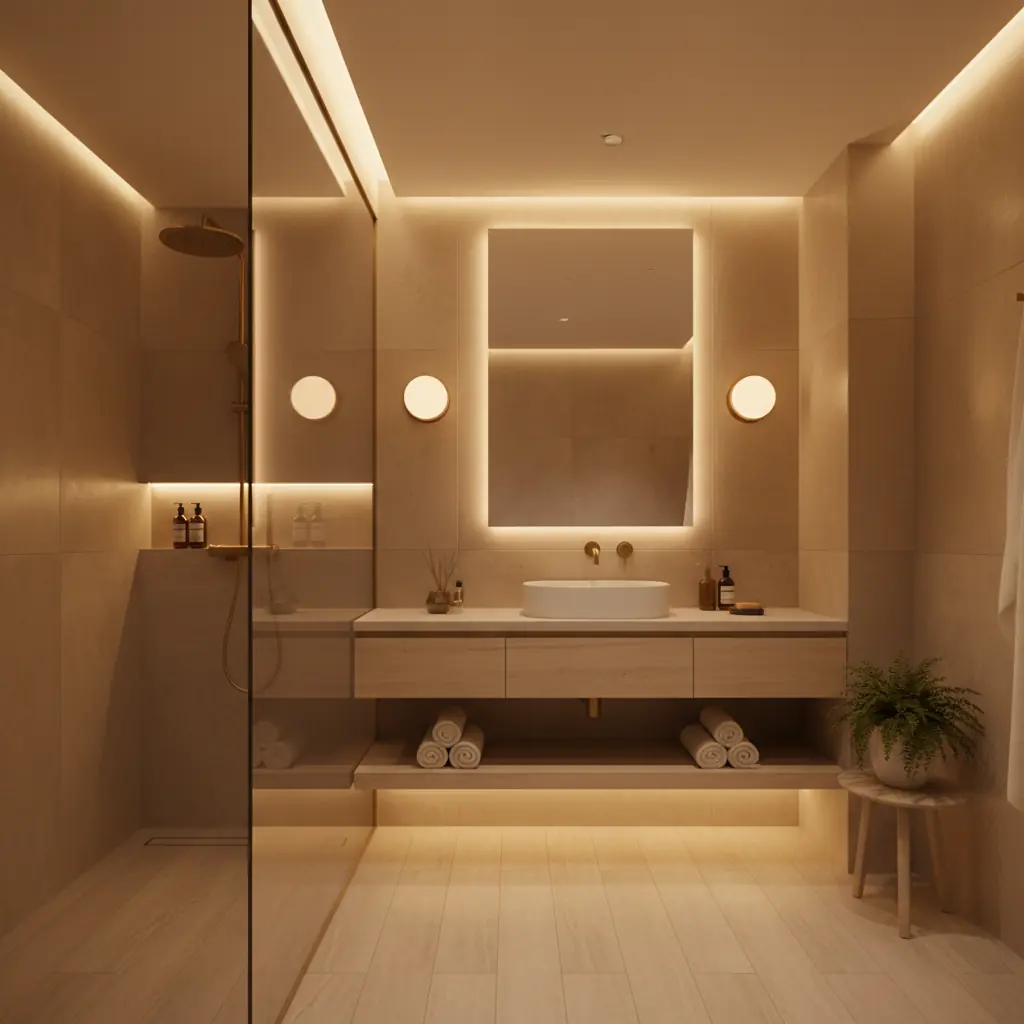
Layer your lighting across at least three zones. Overhead recessed lights (or a flush-mount fixture) provide ambient illumination. Vanity lights flanking the mirror (not just above it) eliminate the under-eye shadows that top-only lighting creates — critical for grooming tasks. A backlit mirror or LED strip under a floating vanity adds a soft ambient glow at the lower part of the room, preventing that top-heavy lighting effect where the ceiling is bright and the floor is dim.
A CRI (Color Rendering Index) of 90 or above ensures colors look accurate under your lights — important for makeup application and for ensuring your tile and paint colors read true. Budget LED bulbs often have CRI around 80, which makes everything look slightly flat and gray. Spending a few extra dollars on high-CRI bulbs is one of the most cost-effective upgrades in a windowless bathroom. A CRI of 90+ can make colors appear up to 15% more vibrant and accurate than lights with a lower CRI, significantly impacting the perceived freshness and appeal of your bathroom.
To fully enhance the experience, integrate dimmers for all lighting layers. This allows you to adjust the intensity, creating a bright, task-oriented environment when needed, and a softer, more relaxing ambiance for unwinding. Consider incorporating LED strips under floating vanities or along toe kicks for an inviting glow that also serves as a subtle night light. For shower areas, ensure you select damp- or wet-rated recessed lighting to extend the layered illumination into every corner of the room. These thoughtful lighting choices transform a potentially gloomy space into one that feels intentionally designed and inviting.
Glass doors, floating vanities, and visual lightness
A shower curtain in a small windowless bathroom is a visual wall. It blocks sightlines, cuts the room in half, and makes the space feel significantly smaller than it is. A clear glass shower door (or even a single fixed glass panel) opens up the entire room visually. You see the back wall of the shower, the tile pattern continues unbroken, and the room reads as one continuous space rather than two cramped compartments. If privacy is a concern, consider a clear glass panel for the main section and a frosted or reeded glass panel for the upper portion, or use smart glass that can switch from transparent to opaque. Embracing an open shower design, where possible, removes even the need for a door, making the space feel truly seamless.
A floating vanity — wall-mounted with open space underneath — is one of the most effective ways to make a small bathroom feel larger. The visible floor area beneath the vanity tricks the eye into perceiving more floor space, and the open area underneath can house a basket or small bin for storage. Combined with a wall-mounted toilet (if plumbing allows), a floating vanity creates a bathroom where the floor is largely uninterrupted, which dramatically changes the sense of spaciousness. Modern bathroom features like floating vanities and frameless showers can increase perceived home value by 3-5%, making these investments worthwhile. When planning a [bathroom remodel](/blog/bathroom-remodel-ideas), prioritizing these elements for their visual and practical benefits is key.
Habitas can help you visualize these changes before committing. Upload a photo of your current bathroom and generate variants with glass shower doors, floating vanities, and different tile options to see which combination works best in your specific space. This is especially valuable in windowless bathrooms where the stakes of a wrong design choice feel higher — you cannot rely on natural light to rescue a bad color or material decision. Habitas can generate multiple design options in minutes, a process that traditionally takes human designers days or even weeks for initial concepts, saving you time and reducing uncertainty.
Plants and scent management in a windowless bathroom
The right plants thrive in windowless bathrooms and do more than decorate — they add life, color, and a sense of freshness that partially compensates for the missing window. Pothos (Epipremnum aureum) is the classic choice: it tolerates low to no natural light, loves humidity, and trails beautifully from a shelf or hanging planter. ZZ plants (Zamioculcas zamiifolia) are nearly indestructible in low light. Snake plants (Sansevieria) handle both low light and the humidity fluctuations of a bathroom. Peace lilies (Spathiphyllum) even bloom in low light and help absorb excess moisture from the air. Other resilient choices include Boston ferns (Nephrolepis exaltata) which love humidity, and air plants (Tillandsia) which require no soil and can be displayed creatively in wall-mounted holders or terrariums, adding a sculptural element. For a comprehensive list of greenery that thrives indoors, check out our guide on [the best plants for interior design](/blog/best-plants-for-interior-design).
For all these plants in a truly windowless room, supplemental light from the bathroom fixtures during daily use (a few hours per day) is usually sufficient. If your bathroom lights are rarely on, a small grow light on a timer (6-8 hours per day) keeps plants healthy without any natural light at all.
Scent management is the invisible design element. Without a window, odors linger. Beyond the exhaust fan (which handles moisture), consider a small plug-in essential oil diffuser or a high-quality scented candle for regular use. Eucalyptus bundles hung from the showerhead release a natural, spa-like scent when steam hits them — they last 2-3 weeks and are inexpensive to replace. For a more sophisticated approach, invest in an automated reed diffuser or a subtle air purifier with a carbon filter, which actively cleans the air rather than just masking odors. Avoid chemical air fresheners that just mask odors with synthetic fragrance. In a small sealed room, subtlety is key, opting for fresh, clean scents like citrus, mint, or cypress.
Frequently Asked Questions
### Is a windowless bathroom a problem for resale value?
While a windowless bathroom typically isn't considered an asset compared to one with natural light, it doesn't necessarily detract from resale value if properly designed. A well-ventilated, brightly lit, and thoughtfully designed windowless bathroom with modern fixtures can be just as appealing to potential buyers as one with a window, especially if it's a powder room or secondary bathroom. The key is to ensure it feels fresh, spacious, and not at all like an afterthought. High-quality ventilation and effective artificial lighting are paramount to avoiding common issues like mold and stale odors, which _would_ negatively impact resale.
### What is the ideal color temperature for windowless bathroom lighting?
For a windowless bathroom, the ideal color temperature for LED lighting is typically between 4000K and 5000K. This range mimics natural daylight, providing a crisp, clean, and energizing ambiance that combats the feeling of being enclosed. While warmer temperatures (below 3500K) can feel cozy in other rooms, they can make a windowless bathroom feel dingy or yellow. Opting for a neutral to cool white helps colors appear more accurate, which is essential for grooming tasks like makeup application, and prevents white tiles from looking off-white.
### Can plants truly survive without any natural light in a bathroom?
Yes, many plants can survive and even thrive in a windowless bathroom, provided they receive supplemental light from your artificial fixtures during daily use. Plants like Pothos, ZZ plants, Snake plants, and Peace lilies are renowned for their low-light tolerance and love the humidity that a bathroom environment offers. If the bathroom lights are rarely on, a small, dedicated LED grow light on a timer (set for 6-8 hours daily) can provide sufficient light to keep them healthy. Beyond aesthetics, some plants can even help absorb ambient moisture, contributing to a fresher atmosphere.
### How can I make a small windowless bathroom feel larger?
Making a small windowless bathroom feel larger involves a combination of visual tricks and smart design choices. Prioritize light-colored walls and large-format tiles to minimize visual breaks and maximize light reflection. Install a large, frameless mirror (or even wall-to-wall) to double the perceived space. Use clear glass shower doors instead of shower curtains to maintain continuous sightlines. Incorporate a floating vanity and wall-mounted toilet to expose more floor area, creating an illusion of spaciousness. Layered, daylight-mimicking LED lighting is also crucial for preventing a cave-like feel.
### What's the biggest mistake to avoid in a windowless bathroom design?